






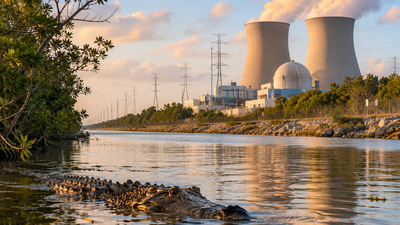
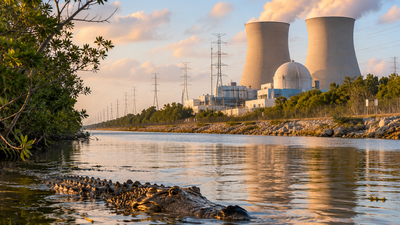
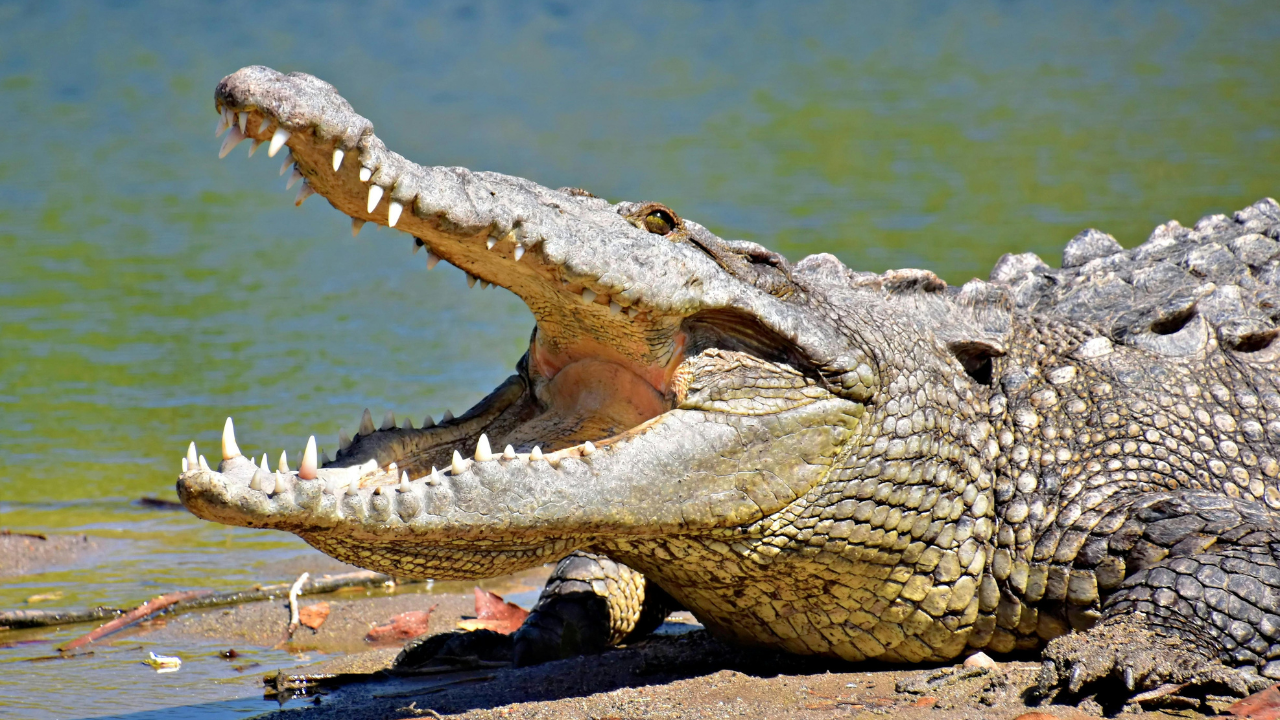
A nuclear power plant is hardly the first place that comes to mind when thinking about wildlife refuges. Yet around Turkey Point, south of Miami, American crocodiles have made themselves at home in a vast network of artificial canals built for the plant. The waterways have become an important habitat for a species that once came close to disappearing from the United States. In 2019, wildlife specialists working at the site rescued dozens of newly hatched crocodiles in a single week, and more were expected. The animals were measured, tagged and relocated as part of a conservation programme that had already been running for decades. The crocodiles living beside a nuclear facility is not only the most fascinating part of the story but its industrial landscape has become an important part of their recovery.
How Turkey Point’s nuclear plant became an American crocodile habitat
Turkey Point’s crocodile population is tied to an enormous man-made landscape. The plant’s canals run for roughly 168 miles, or 270 kilometres, forming a network of waterways and raised banks around the facility. American crocodiles have used these areas for years, turning sections of the artificial landscape into nesting and rearing grounds.By 2019, several hundred crocodiles were living among the canals. The site was estimated to hold around a quarter of the roughly 2,000 American crocodiles then found in the United States, making it one of the country’s three major habitats for the species. The canals provide water and elevated areas where females can lay their eggs. As reported by AP, the surrounding habitat is also managed by wildlife specialists employed by Florida Power & Light, the company operating the plant.
Inside the decades-long programme tracking Turkey Point’s crocodiles
The programme at Turkey Point dates back to 1978, long before the crocodiles became a curiosity associated with the nuclear plant. During the nesting season, specialists prepare parts of the canal system for crocodiles. Vegetation is cleared from selected sections of the raised berms, creating more suitable ground for nesting. Ponds and other habitat features are also maintained.Once the eggs hatch and the young animals are left by their mothers, wildlife workers capture some of the hatchlings.The tiny crocodiles are measured and fitted with microchips before being released or relocated. The tags allow individual animals to be identified later, giving specialists a way to follow their development and survival. By 2019, the programme had tagged about 7,000 crocodile hatchlings.
How Florida’s heat may have shaped Turkey Point’s 2019 crocodile hatchlings
In July 2019, 73 hatchlings were rescued by the Turkey Point wildlife team during one week. More were expected to emerge as the nesting season continued. The number was striking, but the young crocodiles faced a difficult future.Hatchlings are at the bottom of the food chain and many do not survive long enough to become adults. Predators take them, and the hazards of their environment add to the losses. Relocating them cannot guarantee survival, but the work gives some of the young animals a better chance.The 2019 report also highlighted another unusual feature of crocodile reproduction: the temperature inside the nest can influence the sex of the hatchlings. Warmer incubation conditions favour males, while cooler conditions are more likely to produce females.That made the weather of 2019 relevant to the hatchlings being monitored at Turkey Point. According to Michael Lloret, an FPL wildlife biologist and crocodile specialist involved in the programme, the young crocodiles that year appeared to be disproportionately male following an exceptionally hot June.
Why the coastline is becoming a problem
The artificial canals have another advantage that has become increasingly important: they provide nesting ground away from the immediate coast.American crocodiles naturally use coastal areas, but low-lying nests can be vulnerable to seawater. Rising sea levels can flood nesting sites, destroying eggs before they hatch. The raised berms around Turkey Point offer an alternative.Wildlife workers have deliberately encouraged crocodiles to use these areas by maintaining suitable nesting habitat. In practical terms, the programme has created a place where the reptiles can reproduce while avoiding some of the problems faced by nests closer to the coast.That does not make the canals a substitute for natural habitat. They are still part of an industrial facility, and the crocodiles remain exposed to the ordinary dangers faced by young reptiles. But the site has become increasingly valuable because suitable habitat is not distributed evenly across the crocodiles’ range.
The troubled history of American crocodiles in the United States
The presence of hundreds of crocodiles around Turkey Point would have been difficult to imagine during the period when American crocodiles were being heavily hunted in the United States.People killed them for a mixture of reasons, including fear and the value of their hides. Their reputation as dangerous predators did little to protect them from persecution. Yet American crocodiles are generally wary of people.Encounters can happen in South Florida, where crocodiles and humans sometimes share waterways, but attacks are rare. The 2019 AP report cited just one recorded attack in the United States at that point. In 2014, a couple swimming in a South Florida canal were both bitten. Both survived.The contrast between the animal’s reputation and its usual behaviour is important when looking at its history in the United States. A large crocodile can certainly be dangerous, but that does not mean it routinely seeks out people.For much of the species’ history in the country, human activity was a far greater threat to its survival than the crocodiles were to humans.
How protection helped bring America’s crocodiles back from the brink
Protection and conservation efforts gradually changed that picture. In 2007, the American crocodile’s status under the US Endangered Species Act was changed from endangered to threatened. The shift reflected an improvement in the species’ prospects, although it did not mean the crocodile had become free from risk.The site’s wildlife programme has protected nesting areas, monitored animals and tagged thousands of hatchlings over several decades. The artificial canals have also provided habitat in a region where natural coastal environments face increasing pressure.The recovery is therefore not the result of a single intervention. It has involved legal protection, habitat management and long-term monitoring, along with the crocodiles’ own ability to make use of an unexpected environment.

✍️ Vikrant Kharwar
Vikrant Kharwar is the Founder and Editor of News Us Media. He writes about trending news, sports, entertainment, technology, and viral stories. His goal is to make news simple, informative, and easy to understand for readers across the United States and around the world.