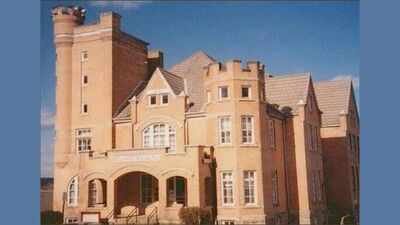








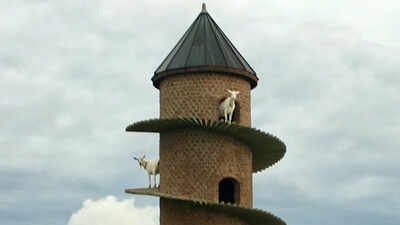
At Quinta da Aveleda, a historic wine estate in Portugal’s Vinho Verde region near Penafiel, a three-storey stone tower stands among the property’s romantic gardens, built not for people but for goats. Known as the Torre das Cabras, or Tower of the Goats, it was constructed in the late 19th century by Fernando Guedes da Silva da Fonseca, a member of the family that has owned the estate since the 17th century. Rather than leaving the estate’s dwarf goats to graze on flat ground, the family built them a miniature mountain instead, complete with a wooden ramp spiralling around the outside so the animals could climb from the ground floor to the top.
Why the Aveleda family built their goats a tower instead of a field
Quinta da Aveleda was founded as a wine-producing estate in 1870 by Manoel Pedro Guedes, though the family’s connection to the property stretches back to the 17th century. According to accounts of the estate’s history published by the family, the Torre das Cabras was conceived as an ode to nature and to earlier generations of the Aveleda family, a three-storey structure built specifically to house dwarf goats within the estate’s gardens. In Portuguese folk tradition, the goat is associated with fertility and abundance, and the family has described the animal as embodying the idea of land that has always been able to produce its finest fruit.The tower belongs to a broader category of structure known as a folly, an ornamental building constructed with no strictly practical purpose beyond aesthetic or symbolic value, a tradition especially popular in European garden design through the 18th and 19th centuries. Aveleda’s gardens contain several such follies scattered throughout the property, including a Victorian-style tea house and a 16th-century Manueline window relocated to the grounds, but the goat tower has become by far the most recognisable.
How the tower’s design actually works for the goats living in it
The Torre das Cabras stands three storeys tall, built from stone with a wooden ramp that spirals around the tower’s exterior, allowing the goats housed inside to move freely between floors under their own power. This design lets the estate’s owners give their goats something closer to the varied, elevated terrain the animals would naturally seek out in the wild, rather than confining them to the flat gardens surrounding the tower.The tower continues to serve this same function today. Small dwarf goats still live in and around the structure, and visitors touring Aveleda’s gardens regularly encounter them making their way up and down the spiral ramp, much as they have for well over a century.
How one family’s garden folly inspired goat towers around the world
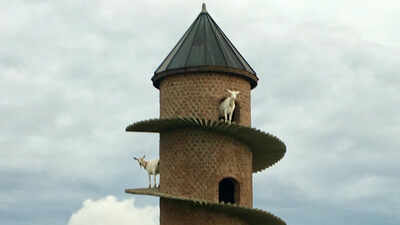
For decades, Aveleda’s tower remained a largely local curiosity, admired mainly by visitors to the estate itself. That changed after a member of the Guedes family, travelling abroad, encountered a second goat tower entirely by chance at Fairview Wine and Cheese in South Africa, unaware at the time that any connection existed between the two. Fairview’s owners had in fact built their own tower in 1981 after the owner’s son visited Aveleda and saw the original Torre das Cabras firsthand, carrying the idea back to South Africa with him.Fairview’s version, built from brick with a steeply sloped metal roof, went on to house a herd of hundreds of Saanen milk goats and became a defining feature of the winery’s brand, drawing considerably wider international attention than Aveleda’s original structure ever had on its own. That renewed visibility helped spark a small wave of similar towers built elsewhere over the following decades, including examples in Norway, Argentina and the United States, among them the Tower of Baaa in Findlay, Illinois, built in 1998 and now recognised as the tallest goat tower of its kind.
Why the tower remains one of Aveleda’s most distinctive features today
More than a century after it was first built, the Torre das Cabras continues to stand as one of the most photographed and talked about features within Aveleda’s roughly eight-hectare historic garden, itself formally classified as a Jardim Histórico, or Historic Garden, by the Portuguese Association of Historic Gardens. Set among sequoias, Japanese cedars and other rare plantings collected by successive generations of the Guedes family, the goat tower remains a genuinely functional piece of animal housing rather than a purely decorative relic, still home to live goats climbing the same spiral ramp their predecessors used generations earlier.What began as one family’s unusual solution to housing their goats has since become, almost by accident, an internationally recognised architectural curiosity, copied by winemakers and farmers on at least four continents, each building their own version of a mountain for animals that, as the Guedes family apparently once decided, simply did not belong on flat ground.

✍️ Vikrant Kharwar
Vikrant Kharwar is the Founder and Editor of News Us Media. He writes about trending news, sports, entertainment, technology, and viral stories. His goal is to make news simple, informative, and easy to understand for readers across the United States and around the world.