








An archer steps up to the line, pulls back the bowstring and releases an arrow that hits a bullseye two hundred yards away through thick fog. The crowd applauds the incredible skill needed to make a shot that almost nobody else could manage.Then another marksman steps forward, turns forty-five degrees away from the target range and fires an arrow into an empty part of the forest. Moments later, a target that nobody knew was hanging there falls from a high branch.“Talent hits a target no one else can hit. Genius hits a target no one else can see,” wrote the German philosopher Arthur Schopenhauer.The difference challenges the common idea that talent and genius are simply different levels of the same ability. Talent is a quantitative advantage. It means being extremely good at working within existing rules, tools and systems. Genius is different. It is a qualitative change: the ability to see possibilities that other people do not even recognize.
A lonely philosopher’s view of human ability
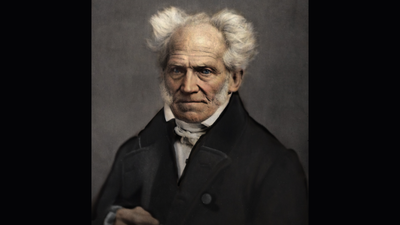
Arthur Schopenhauer published this metaphor in the expanded 1844 edition of The World as Will and Representation (Die Welt als Wille und Vorstellung), in Chapter 31, titled “On Genius.”In the original German, Schopenhauer wrote: “Das Talent gleicht dem Schützen, der ein Ziel trifft, welches die Uebrigen nicht erreichen können; das Genie dem, der eines trifft, bis zu welchem sie nicht ein Mal zu sehn vermögen.”When Schopenhauer wrote these words in 1844, he was a bitter and largely ignored academic living in Frankfurt. The first edition of his major work, published in late 1818, had been a commercial failure. Many copies were eventually sold as wastepaper. For years, he watched contemporaries such as Georg Wilhelm Friedrich Hegel receive fame, university positions and public admiration, while Schopenhauer’s own university lectures attracted very few students.Schopenhauer believed that talent usually belongs to its own time. A talented person becomes highly skilled at answering questions that society is already asking. Because their abilities fit existing needs, they can receive recognition, money and praise quickly.Genius works differently. Schopenhauer compared it to something like a comet entering an orderly planetary system. Because a genius works toward a goal that other people cannot yet understand, their ideas may be met with silence, confusion or even hostility during their lifetime.
The philosophy of seeing beyond the self
To understand this difference, we need to look at Schopenhauer’s larger theory of consciousness. He argued that ordinary human thinking is controlled by what he called the “Will”—a blind and constant drive toward survival, self-interest and reproduction.Talent usually works in service of this Will. A talented person uses a powerful intellect to solve practical problems, win competitions or master an existing craft. Their mind may be extremely sharp, but it remains connected to personal goals and the demands of society.Genius appears when the intellect can temporarily escape these demands. Schopenhauer described genius as the ability to enter a state of “pure contemplation.” In this state, a person becomes deeply objective and temporarily forgets their ego, desires and personal situation in order to see things more clearly.Because the genius is less controlled by immediate practical needs, they can notice fundamental truths, artistic forms or scientific principles that other people overlook.This helps explain why major discoveries can sometimes look strange or even foolish to people living at the time. When Gregor Mendel discovered the basic laws of genetic inheritance through his pea plant experiments in 1866, the scientific world largely ignored his published work. It took about thirty-five years for his findings to receive serious recognition. Mendel had identified important patterns of heredity at a time when biology did not yet have the concepts or language needed to fully understand what he had found.
Knowing the difference between optimization and real innovation
In 2026, Schopenhauer’s distinction remains useful for thinking about business, technology and personal development.Modern culture often mistakes extreme optimization for genius. High-frequency trading systems, machine-learning models that break performance records and highly efficient supply chains can represent extraordinary levels of talent. They hit known targets with speeds and accuracy that ordinary people cannot match.But true genius can change the target itself.Consider the development of personal computing and digital media. While many traditional companies were focused on improving existing systems, researchers such as Alan Kay at Xerox PARC were imagining graphical user interfaces, object-oriented programming and portable computers. These ideas went beyond simply making existing tools faster or more efficient. They suggested entirely different ways of interacting with technology.Schopenhauer’s idea can therefore help us decide what kind of thinking a problem requires.
- For known problems, use talent. Improve your techniques, learn established methods and practice carefully until you can meet clear goals more effectively.
- For problems caused by stagnation, make room for genius. Question basic assumptions, step away from immediate measurements and ask what possibilities are being ignored simply because they do not fit current systems.
Talent is the ability to hit a target that others struggle to reach. Genius is the ability to notice that there is another target altogether.Schopenhauer understood that talent often receives quick recognition because it solves the problems of its own time. Genius is different. It may produce ideas that seem useless, strange or impossible at first because society does not yet know what to do with them.The genius therefore works ahead of the crowd, aiming at something that others cannot yet see. Recognition may come much later, when the world finally catches up with the target.

✍️ Vikrant Kharwar
Vikrant Kharwar is the Founder and Editor of News Us Media. He writes about trending news, sports, entertainment, technology, and viral stories. His goal is to make news simple, informative, and easy to understand for readers across the United States and around the world.