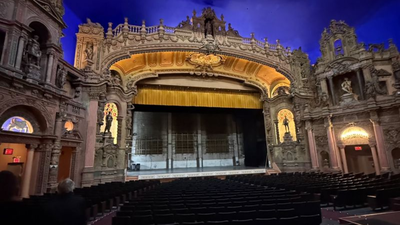









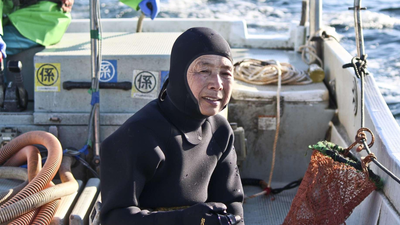
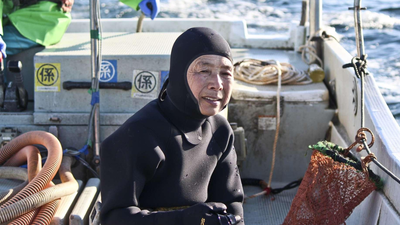
For generations, women along Japan’s Ise-Shima coastline have entered the sea without scuba equipment or oxygen tanks to gather seafood from the seabed. Known as Ama, or ‘women of the sea’, these traditional free divers rely on breath-holding, years of experience and an intimate knowledge of the ocean. Some have continued the demanding work well into their 70s and 80s. In 2012, The Japan Times profiled Reiko Nomura, an 80-year-old former Ama diver in Osatsu, Mie Prefecture, who had spent most of her life diving for abalone and other sea creatures. Today, the tradition survives mainly in coastal communities, although the number of active Ama continues to decline.
Japan’s ‘women of the sea’ dive without oxygen tanks
Ama, a Japanese term commonly translated as ‘woman of the sea’, are traditional female free divers who collect marine life directly from coastal waters. Unlike scuba divers, they do not carry air tanks. They dive on a breath, search the seabed and return to the surface before taking another breath.Japan’s National Tourism Organization says experienced Ama can free-dive to around 15 metres and hold their breath for up to about 60 seconds. Their catches can include abalone, turban shells, sea urchins, sea cucumbers and seaweed.The practice is particularly associated with Toba and Shima in Mie Prefecture, where many of Japan’s remaining Ama continue to work. Ise-Shima’s coastline, with its bays and rich marine environment, has provided the setting for this distinctive fishing culture for generations.
The tradition dates back thousands of years
Ama diving is frequently described as a tradition dating back more than 3,000 years. Japan’s tourism authorities describe the practice as being part of the country’s ocean-fishing culture for three to five thousand years, while other official material places its documented history more conservatively, noting references to Ama in the eighth-century Man’yoshu poetry collection.This means the safest description is that Ama diving is an ancient tradition with thousands of years of history, rather than claiming that today’s exact diving practices have remained unchanged for precisely 3,000 years.The knowledge required for the work has traditionally been passed from one generation to another. Experienced divers learn how to recognise productive areas, understand changing sea conditions and harvest marine life without exhausting local resources.
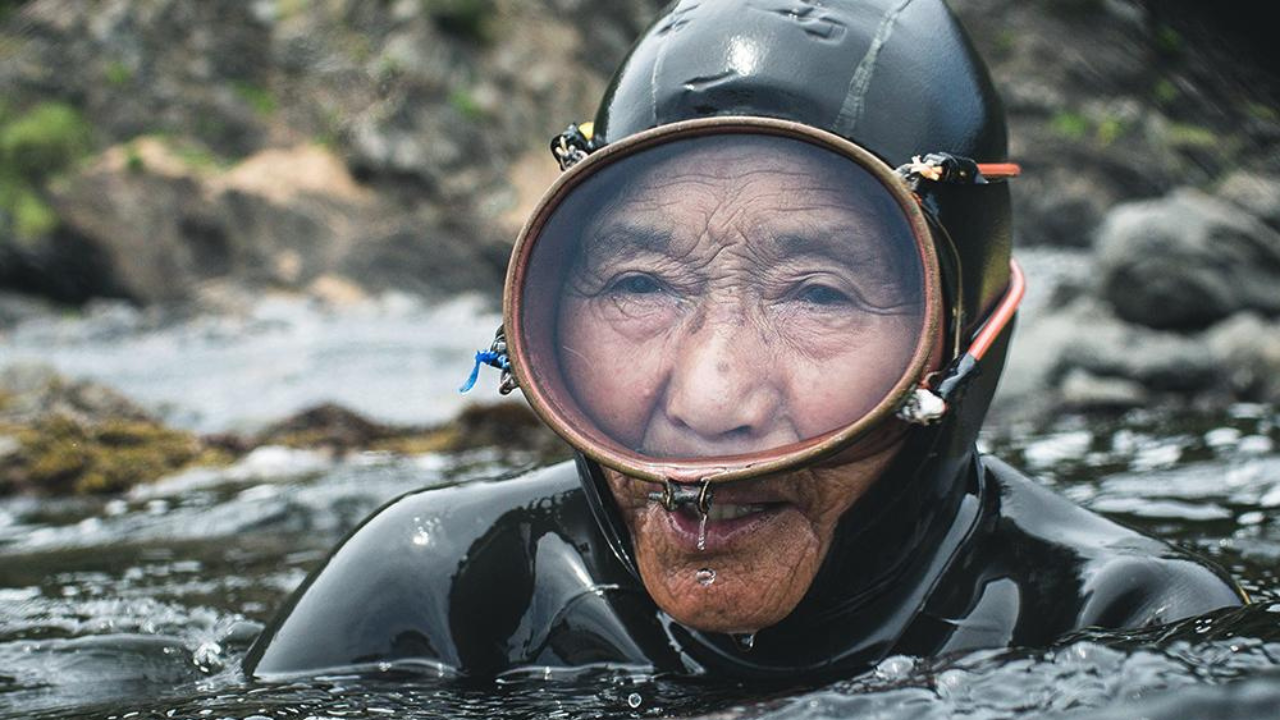
Award-winning photograph by Kaho Wong, 2017
An 80-year-old Ama became a symbol of the tradition
One of the best-documented elderly Ama divers is Reiko Nomura, who was profiled by The Japan Times in 2012 at the age of 80.Nomura grew up surrounded by Ama culture in Osatsu, a coastal village in Mie Prefecture. According to the report, she began diving when she was about 10 and spent most of her life beneath the waves, collecting abalone and other sea creatures.However, there is an important detail often lost in social-media versions of her story. Nomura was no longer actively diving when she was profiled at 80. The Japan Times reported that she had stopped diving a few years earlier and was working as a host at an Ama hut.She nevertheless remained closely connected to the tradition, welcoming visitors, preparing food and sharing stories about her decades as a diver.
What do Ama divers collect from the sea?
Ama catches vary according to the location and season, but the seafood associated with the tradition includes abalone, turban shells, sea urchins, sea cucumbers and spiny lobster.Seaweed is also an important part of the traditional catch. Japan’s National Tourism Organization says Ama divers gather various types of seaweed alongside shellfish and other marine products.Abalone has a particularly important place in the culture of the Ise-Shima region. Fresh abalone and turban shells harvested by Ama have even been used as sacred offerings connected with Ise Jingu.
Their work depends on knowing the sea
Ama diving is not simply a matter of swimming underwater and collecting whatever can be found.The divers depend on detailed knowledge of the coastline, seabed and marine life. They also have to judge weather and sea conditions before entering the water.Traditional fishing rules are designed to prevent excessive harvesting. Restrictions can determine which species may be collected, their size, the fishing season and how long divers can remain in particular areas.The system reflects a long-standing understanding that the Ama communities depend on the same marine resources year after year. Japan’s tourism authorities describe the practice as a form of traditional sustainable fishing in the Ise-Shima region.
Modern Ama still use relatively simple equipment
The image of an Ama diver wearing only traditional white clothing is strongly associated with the culture, but modern Ama generally use equipment suited to contemporary conditions.Many now wear wetsuits, goggles and fins. The breathing method, however, remains fundamentally different from scuba diving because they do not rely on an air tank.Traditional photographs often show divers wearing white garments and carrying simple equipment. The clothing has become an important cultural symbol, even though working divers today commonly use modern protective gear.Ama huts bring divers and visitors togetherThe culture does not end when the divers return from the water.In places such as Osatsu, visitors can meet Ama at traditional huts where they rest, warm themselves and prepare seafood. Some of these experiences allow visitors to hear directly from the divers about their lives and work.At Ama Hut Hachiman in Toba, visitors can watch Ama prepare and grill seafood such as abalone and spiny lobster while learning about their traditional way of life.The huts have therefore become an important part of cultural tourism while also providing a way for the remaining Ama to share their knowledge with people from outside their communities.
The number of Ama divers is falling
Behind the fascinating images of elderly women diving into the sea is a serious concern for the future of the tradition.The number of Ama has fallen sharply over the past several decades. Japan’s National Tourism Organization says there were about 9,100 Ama across Japan in 1978, compared with roughly 2,000 today. It says around half of the remaining Ama are concentrated around the Shima and Toba areas of the Shima Peninsula.The figures vary depending on the geographical area and how active divers are counted, but the long-term decline is clear.An ageing workforce is one of the biggest challenges. Younger women are increasingly choosing other careers, while older Ama eventually retire from the physically demanding work.
Some communities are struggling to find younger divers
The problem is particularly visible in some smaller coastal communities.Reuters reported in 2024 that the number of Ama in the Shirahama district of Minamiboso had fallen to 40 in 2023, down 70% from 2006. Their average age had increased from 68 to 72 during that period.The work can be physically demanding and relatively poorly paid, making it difficult to persuade younger people to take it up as a livelihood.Still, there are women trying to keep the practice alive. Reuters reported that Ayumi Inoue, who was 51 at the time, had trained to become an Ama after growing up watching older women in her community practise the tradition.
Changes in the ocean add another challenge
The decline in the number of divers is not the only threat.Ama communities also depend directly on the health of coastal ecosystems. Changes in marine resources can affect the species they traditionally harvest and make the work less predictable.Japan’s tourism authorities have highlighted the decline in ocean resources as another major concern for Ama communities. As the availability of marine life changes, the economic viability of traditional free-diving becomes more difficult.For the Ama, the loss of marine resources can therefore threaten both their livelihoods and the cultural practices associated with them.Despite these pressures, Ama diving has not disappeared.Japan’s National Parks service says there are still more than 600 Ama working in Mie, while Toba and Shima remain the heartland of the tradition.The remaining divers continue to enter the water using breath-hold techniques that have been passed down through generations. Some work well into their later years, while others eventually move into roles that allow them to share their knowledge without continuing the physical demands of diving.

✍️ Vikrant Kharwar
Vikrant Kharwar is the Founder and Editor of News Us Media. He writes about trending news, sports, entertainment, technology, and viral stories. His goal is to make news simple, informative, and easy to understand for readers across the United States and around the world.