








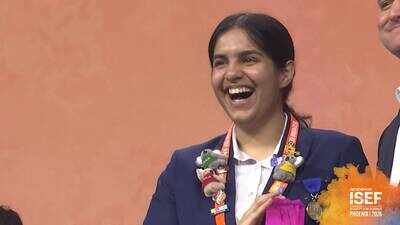
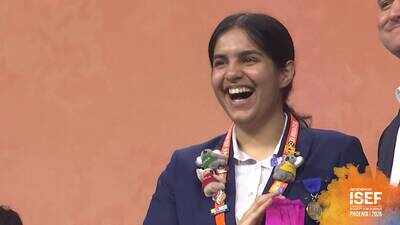
Anusha Arora, a 15-year-old student from Bellevue, Washington, has won the inaugural F. Thomson Leighton and Bonnie Berger Family Prize for STEM Excellence at Regeneron ISEF 2026 after developing an AI-powered music therapy platform designed to make personalised support more accessible.As per Society for Science report, her project, called “Harmony”, uses finger sensors to gather physiological data, while 11 AI programmes work together to detect a user’s emotional state and generate music and visuals in real time. Arora received $50,000 for the project, which was recognised for applying advanced technology to a significant challenge involving mental health and access to music therapy.Arora’s idea was inspired by a personal experience involving her mother. Explaining the origins of Harmony, she said, “The main inspiration was a little personal experience with my mother and I saw how music could really calm her down and reduce her stress.” That observation led the teenager to explore whether artificial intelligence and sensor technology could create a more personalised music therapy experience. In experiments conducted as part of her research, participants using the platform showed reductions in stress and anxiety and remained more engaged during therapy sessions.
How Harmony works
Harmony is designed as a portable platform that responds to changes in a user’s emotional state rather than relying on a predetermined playlist.Finger sensors provide physiological input that the system analyses. Its AI models then interpret the data and generate music and accompanying visuals intended to correspond with the user’s emotional state.The platform combines 11 AI programmes to perform different aspects of emotion detection and music generation, allowing the system to adapt its output in real time.The idea is to create an experience that changes alongside the user rather than providing the same music throughout an entire session.
What did Anusha’s experiments show?
Arora tested Harmony through several experiments to examine how users responded to adaptive music therapy.According to the project findings, participants using the device showed reductions in stress and anxiety. They also remained more engaged during the sessions.The results are significant because engagement can be an important factor when people are using therapeutic interventions. Arora’s project explores whether personalised music generated in response to emotional data can make sessions more responsive and engaging.However, Harmony remains a research project and should not be considered a replacement for professional mental health care.
Why Anusha focused on music therapy
Arora’s project addresses a broader accessibility problem.Although music therapy is recognised as a way of supporting mental health and wellbeing, access can be limited by treatment costs, shortages of providers and a lack of insurance coverage.Harmony was developed as a portable technology-based approach that could potentially make personalised music-based support easier to access.Rather than simply generating music using AI, the project attempts to connect music generation with physiological signals and emotional responses.
Anusha wins $50,000 STEM award
Arora received the F. Thomson Leighton and Bonnie Berger Family Prize for STEM Excellence, a new Grand Award introduced at Regeneron ISEF.The award carries a $50,000 scholarship, which can be applied by the winner to the educational institution of their choice.The prize is awarded to a finalist who best demonstrates excellence in applying advanced mathematics and technology to solve significant global challenges.Its judging criteria include projects at the convergence of theoretical mathematics and algorithm design, practical computer science and distributed computing, computational biology and large-scale data analysis, as well as cloud computing, cybersecurity and content delivery.The award honours the spirit of innovation associated with F. Thomson Leighton and Bonnie Berger and their contributions to mathematics, computer science and technology.
Anusha’s message after winning
In footage from the awards, Arora reflected on the significance of having her work recognised.“The work that I’m doing is actually beneficial. Keep researching. Keep pursuing science and technology,” she said.Her message reflects the broader objective of the competition – encouraging young researchers to continue developing ideas that could eventually have real-world applications.
What is Regeneron ISEF?
The Regeneron International Science and Engineering Fair brings together high school students from around the world to present original scientific research and engineering projects.More than 1,700 young scientists and engineers representing 64 countries, regions and territories participated in the 2026 competition.The finalists collectively received more than $7 million in awards, with prizes recognising creativity, innovation and scientific inquiry.Top awards ranged from $10,000 to $100,000 and were designed to support students’ education and continued research.The 2026 ceremonies were held at the Phoenix Convention Center in Phoenix, Arizona. The Special Awards Ceremony took place on May 14, followed by the Grand Awards Ceremony on May 15.
Society for Science praises young researchers
Maya Ajmera, President and CEO of Society for Science and Executive Publisher of Science News, congratulated the winners and highlighted the range of backgrounds and disciplines represented at ISEF.“These students never fail to inspire me,” Ajmera said, adding that the young researchers were addressing urgent challenges with “rigor, imagination, and determination.”She also expressed optimism about the future, pointing to the students as evidence of what young scientists can achieve when given opportunities to pursue ambitious research.Regeneron co-founder, co-chairman, president and chief scientific officer George D. Yancopoulos also congratulated the winners.“My own scientific journey began in high school, supported by great teachers, driven by a fearless youthful belief that I could cure my grandmother’s disease, and inspired by the excitement and challenge of science competitions,” he said.Yancopoulos added that he believes “the best hope for overcoming the greatest threats facing humanity lies in inspiring brilliant young minds to take on these challenges.”

✍️ Vikrant Kharwar
Vikrant Kharwar is the Founder and Editor of News Us Media. He writes about trending news, sports, entertainment, technology, and viral stories. His goal is to make news simple, informative, and easy to understand for readers across the United States and around the world.