









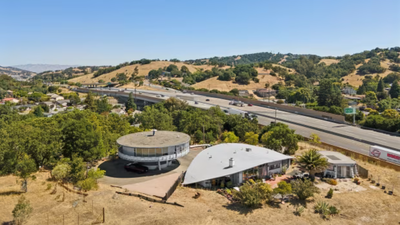
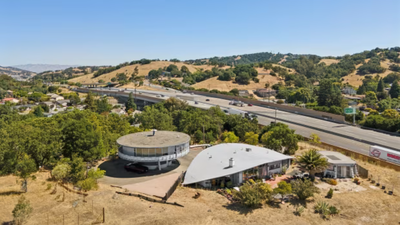
In 1963, a California builder constructed a circular home that can turn 320 degrees using two washing machine motors. Sixty-three years later, the unusual property overlooking Highway 101 in Novato is on the market for the first time, reports the Wall Street Journal. The listing includes the rotating house along with six other detached homes on a 2.25-acre property. The entire complex is priced at $3.3 million. All seven homes are currently occupied by tenants. The unusual house was built by Sam Harkleroad, an eccentric local builder and inventor who died in 1993 after constructing dozens of unusual homes across Marin County. “He was tired of the same old houses,” says his grandson Harold Pozzi, 71. “He thought normal houses were boring.” Pozzi, a retired truck driver who has looked after the property for 60 years, decided to sell because maintaining it had become too difficult. He is selling the property on behalf of himself and his late brother’s children through commercial real estate firm Marcus & Millichap.
Mechanical design and freeway relocation
Harkleroad designed the 1,560-square-foot house around a central cylindrical pillar containing flexible gas, water and sewage pipes. The utility lines can move enough to let the house turn 320 degrees, or eight-ninths of a full circle, before changing direction. “He liked a challenge,” Pozzi says of his grandfather. The rotating system is powered by two standard washing machine motors. Pozzi says it still works, although the house was never designed to rotate constantly like a revolving restaurant. “It’s got to be checked once in a while,” he says. “Everything seems to be fine right now. You don’t turn it unless you have a reason to.” The house has a raised floor that creates covered parking underneath. The upper level has three bedrooms, two bathrooms, a wraparound terrace and large windows. Soon after Harkleroad finished the house in the early 1960s, state authorities acquired the land to build Highway 101. Harkleroad later bought the house back from the state, borrowed a bulldozer from a friend and moved the entire structure to its current hilltop location overlooking the freeway.
A legacy of thrift and unusual architecture
Harkleroad built the circular house for about $17,000 and kept costs down by getting corporate sponsorships. According to Pozzi, appliance company Tappan provided free kitchen appliances in exchange for Harkleroad opening the house to public tours for several months after it was completed. A 1986 profile in the Los Angeles Times documented Harkleroad’s history of building 25 homes across Marin County using recycled materials and salvaged structures. In one case, he built an entire house on top of a flatbed truck frame for $122. Harkleroad grew up on a farm in Fresno, where he finished his formal education after high school. “If you wanted toys, you built them,” Harkleroad told the Los Angeles Times in 1986. “You didn’t have a million dollars to spend like the kids today.” After moving to the San Francisco Bay Area, he worked as a ship rigger, tree surgeon, fruit picker and truck driver before buying land in Novato in the 1940s. He built a workshop next to the round house and installed a homemade wind turbine on its roof using pieces of steel oil drums. On windy days, the generator powered his tools without electricity from the grid.
Valuing a one-of-a-kind property
The 2.25-acre property contains a mix of unusual buildings. The closest is a home locally known as the “potato chip house,” which Harkleroad built in 1959. Its name comes from its curved roof, designed as a hyperbolic paraboloid that touches the ground at two points. The other five houses have more traditional designs. Setting a sale price was difficult because there are no similar properties nearby, according to listing agent Angelo Baglieri, senior director of investments at Marcus & Millichap in San Francisco. Baglieri got the listing after calling Pozzi without knowing him 10 years ago and staying in contact until Pozzi was ready to sell. He says the valuation considered the current rental income, nearby property sales, the value of the 2.25-acre land and the historical importance of the buildings. Potential buyers could include property developers who want to redevelop the site or private buyers who want to preserve its unusual architecture. “Or,” Baglieri says, “it might be a tech billionaire who says, ‘I just have to have that.’” Pozzi is doubtful about that possibility. “Would a billionaire want to deal with seven rentals?” he asked during a joint interview. Pozzi has mixed feelings about whether the round house will survive under new ownership, but he knows the building has become a familiar part of the local landscape. “Everybody who travels on the 101 knows the round house,” Pozzi says. “A lot of people wouldn’t want to see it go.”

✍️ Vikrant Kharwar
Vikrant Kharwar is the Founder and Editor of News Us Media. He writes about trending news, sports, entertainment, technology, and viral stories. His goal is to make news simple, informative, and easy to understand for readers across the United States and around the world.