








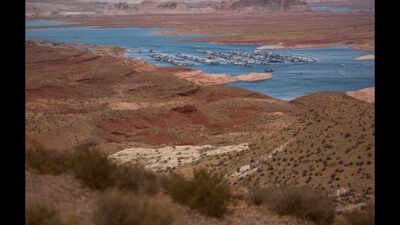
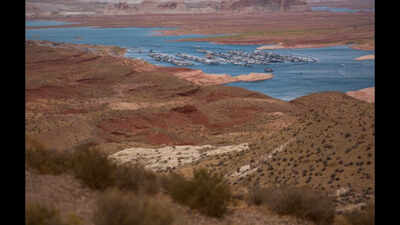
Lake Powell has fallen to a record-low elevation, 20 feet lower than it was at the beginning of 2026. The decline is not unexpected as scientists have been warning against this approaching doom. Lake Powell is the second-largest man-made reservoir in the YS by totak capacity, second to Lake Mead downstream.Situated primarily within San Juan, Kane, and Garfield counties in Utah, with its southern tip anchored in Coconino County, Arizona, Lake Powell was created by the impoundment of the Colorado River via the massive Glen Canyon Dam. Extending roughly 186 miles upstream into deep sandstone canyons, Lake Powell sits at the heart of the Colorado River Basin system, serving as the critical hydrological junction between the Upper Basin states of Colorado, Utah, Wyoming, and New Mexico, and the Lower Basin states of Arizona, California, and Nevada, as well as Mexico.Lake Mead also reached its historic low, straining the Colorado River System.Salt Lake Tribune reported that the reclamation bureau Friday released its two-year operating plan. According to it, the Trump administration won’t force Utah and other Upper Basin states to cut their Colorado River water use over the next two years, but Lower Basin states like California will collectively slash their consumption by over 1 million acre-feet per year.
What happens if the water level goes down further
A “24-Month Study” published in April 2026 estimated that Lake Powell could decline below 3,490 feet in August without major intervention. The Bureau of Reclamation has already taken steps intended to stabilize Lake Powell. Earlier this year, the agency said it planned to move as much as 2.48 million acre-feet of water into Powell by reducing releases from the reservoir and drawing on water from upstream Flaming Gorge Reservoir. Reclamation projected that the steps taken could raise Powell’s elevation to an estimated 3,500 feet by April 2027.Glen Canyon Dam’s hydroelectric turbines require the reservoir to remain above approximately 3,490 feet, known as the minimum power pool. Powell is now only about 30 feet above that threshold. If the reservoir falls below it, Glen Canyon Dam would no longer be able to generate hydropower through its turbines.The Colorado River Basin experienced prolonged drought and increasing temperatures, which eventually led to the present situation.
No, it’s not time to let Lake Powell go
Utah Governor Spencer Cox said it’s definitely not time to let Lake Powell go. “What I will say is we have a framework with the Department of Interior. You all have seen it, you all have reported on it. We need to keep Lake Powell from hitting deadpool. That’s important. There are really hard sacrifices that every state has to make as we move forward with preserving the Colorado.” he said.
Propping up Lake Powell is not a long-term solution: Experts
Since Lake Powell needs a minimum level to keep generating power, the Reclamation Bureau brings water from Flaming Gorge to sustain Lake Powell. But Flaming Gorge takes a severe hit, dropping its surface elevation by as much as 25 to 35 feet and reducing its total capacity from around 82% down to 59%. This creates major disruptions for local tourism and regional economies in Utah and Wyoming, leaving boat ramps high and dry and forcing marinas to relocate docks further into the receding reservoir. Experts feel this can’t be a permanent solution.This band-aid solution also affects the water supplies in the Lower Basin states of California, Nevada and Arizona and a push for conservation in the Upper Basin states of Utah, Wyoming, New Mexico and Colorado

✍️ Vikrant Kharwar
Vikrant Kharwar is the Founder and Editor of News Us Media. He writes about trending news, sports, entertainment, technology, and viral stories. His goal is to make news simple, informative, and easy to understand for readers across the United States and around the world.