





Around 1,800 years ago, a Roman household in what is now Turkey decorated the floor of its home with a detailed mosaic showing animals and mythological figures. Among them were a cat and a dog whose names were written beside their images. Archaeologists have now uncovered the mosaic at the ancient city of Adramytteion on Turkey’s Aegean coast.The colourful floor was part of a Roman villa dating to the late second to third centuries AD, according to Live Science report. The residence had three halls arranged around a central atrium, along with several smaller rooms and a network of pipes and drains that may have been connected to a latrine. One of the halls appears to have been used as the main reception area of the villa.It was here that archaeologists found the large mosaic. The floor decoration measures about 16.4 by 11.8 feet (5 by 3.6 metres) and is divided into 15 separate panels arranged in three rows. Most of the panels show animals, including birds, fish and felines. Two others feature mythological figures- a gorgon, possibly Medusa, and a winged horse, possibly Pegasus.The mosaic was made using tiles in several colours, including white, black, red, orange, yellow, pink, burgundy, blue, turquoise and green. But among all these images, two animals stand out because their names were included in the artwork. One is a light-coloured cat called Emerald. The other is a dog named Ocean.
Emerald The Cat Was Shown Resting On A Cushion
The panel showing Emerald was positioned on the left side of the room as a visitor entered. It depicts a pale-coloured cat sitting on a blue-green cushion. Above the animal are Greek letters spelling “Zmaragdin”, meaning emerald.The way the cat is shown has helped archaeologists consider what its role may have been in the household. Emerald is sitting calmly on a cushion rather than being shown as a wild or stray animal. This suggests that the cat may have been a pet.Archaeologist Hüseyin Özgen, head of the Adramytteion research team at Mimar Sinan Fine Arts University, wrote about the mosaic in a study that is forthcoming in the Journal of Mosaic Research. He noted that Emerald and Ocean may preserve the memory of animals familiar to the people who lived in the villa.There is also a possible explanation for why the cat was given the name Emerald. Özgen suggested that the name could be connected to Roman Egypt, where emeralds were mined in antiquity. The villa’s owner may have had trading connections with North Africa, although this remains a possible explanation for the name.
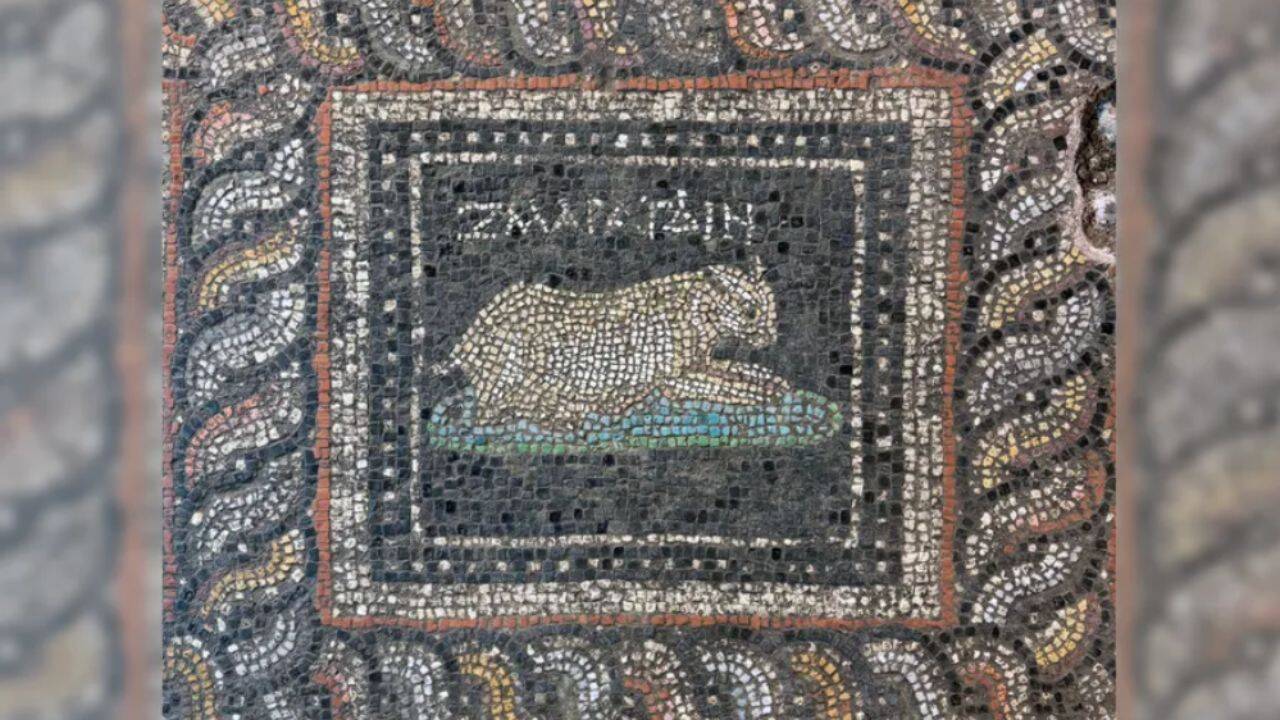
One panel of the mosaic depicts a light-colored cat named Emerald resting on a blue-green cushion.
Ocean The Dog Was Named In Greek
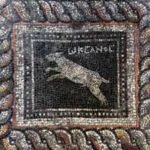
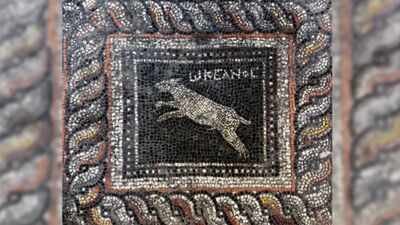
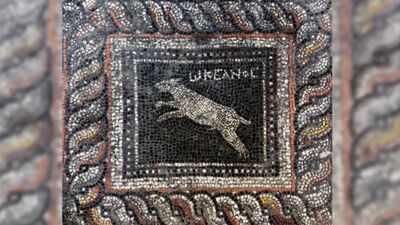
On the right side of the room, another panel shows a dog running or leaping. The animal is labelled with the Greek letters “Okeanos”, meaning ocean.The name may have had a connection with the location where the villa stood. Adramytteion was a harbour city, and Özgen suggested that the dog may have been given the name Ocean because of its surroundings.Unlike the other animals in the mosaic, Emerald and Ocean are specifically named. This makes their panels particularly interesting to archaeologists because the names could provide a small glimpse into the lives of the people who used the villa.The two animals may have been pets, but the evidence does not establish this with certainty. Özgen wrote that Emerald and Ocean were likely familiar to the villa’s residents, even if they were not specifically household pets. Their images may have also served as familiar signs of ownership and household identity.
Villa Was Excavated Recently
The discovery is part of ongoing archaeological work at Adramytteion. Özgen began excavations at the ancient site in 2012, but the Roman villa was discovered only recently. Archaeologists excavated the residence in 2025 and early 2026.During the Roman period, Adramytteion was a provincial capital in Asia Minor. Its position at the head of a gulf on the Aegean Sea also made it an important trading location.The villa appears to have been an impressive residence. It included three halls with mosaic floors, several secondary rooms and the system of pipes and drains. According to Özgen, visitors approaching the residence from its courtyard would have entered towards the largest and most elaborate mosaic in the home.Research at Adramytteion is continuing. The findings on the mosaic are included in Hüseyin M. Özgen’s 2026 study, Mosaic Programmes and Architectural Transformation in an Atrium-Centred Roman-Period Residence at Adramytteion: The North, East and South Halls, forthcoming in the Journal of Mosaic Research.

✍️ Vikrant Kharwar
Vikrant Kharwar is the Founder and Editor of News Us Media. He writes about trending news, sports, entertainment, technology, and viral stories. His goal is to make news simple, informative, and easy to understand for readers across the United States and around the world.