







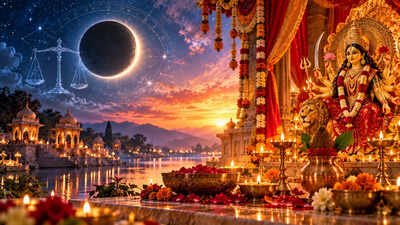
On Saturday, October 10, the Moon goes dark. It’s the New Moon in Libra, landing at 11:50 a.m. Eastern on a date that numerology fans already have circled: 10/10.A few hours later, in India, families will lay out a clay pot, a coconut, and a handful of barley seeds. By sunrise on October 11, Navratri will begin.Plenty of people in the West will read that as a neat coincidence. It isn’t. Navratri starts after a new moon every single time, and the reason why tells you a lot about how the Hindu calendar works.
The Hindu Calendar Runs on the Moon
Most of the world uses a solar calendar. Dates stay put. Christmas is always December 25.Hindu festivals follow a lunar system instead. The basic unit isn’t a day but a tithi, a lunar day. One tithi passes every time the Moon moves 12 degrees ahead of the Sun. Thirty of them make a lunar month.The count resets at the new moon. That’s the exact moment the Moon and Sun line up. As soon as the Moon starts pulling away again, the first tithi of the bright half of the month begins. It’s called Shukla Pratipada.And Navratri always starts on Shukla Pratipada.So check the timing this year. In Indian time, the New Moon happens at about 9:20 p.m. on October 10. Pratipada begins at 9:19 p.m. that same night. They’re essentially the same moment, because one creates the other.Hindu festivals are counted from sunrise, though. So the first morning after Pratipada begins, October 11, is Day 1.
Nine Nights of a Growing Moon
Here’s the part that’s quietly beautiful. Because Navratri starts right after the new moon, the Moon gets brighter every single night of the festival.Night one, it’s a thin silver sliver near sunset. By night nine, it’s more than half full. The festival celebrates a goddess defeating darkness, and the sky literally shows light growing night by night.Then about five days after Navratri ends, the Moon is full. In India, that night is Sharad Purnima, when families leave rice pudding out under the moonlight. In the West, the same full moon is known as the Hunter’s Moon. Same Moon, two cultures, one big round light in the sky.
Two Navratris, Two Equinoxes
The name Sharad Navratri gives another clue. Sharad means autumn.There’s a second major Navratri every year too, called Chaitra Navratri, in spring. One falls near the September equinox, the other near the March equinox. Both mark turning points, when day and night are close to equal and the seasons change.Ancient calendars all over the world paid close attention to these balance points. Navratri is India’s way of marking them with nine nights of devotion.
Why Libra Fits So Well
In Western astrology, this year’s New Moon falls in Libra, the sign of the scales. Libra is all about balance, fairness and setting things right.Navratri’s central story is about exactly that. The buffalo demon Mahishasura had thrown the world out of balance, and no god could defeat him. Durga fought him for nine days and restored order.
What About the 10/10 Portal?
The 10/10 portal is a modern Western overlay. Still, the themes rhyme. The number 1 stands for beginnings and 0 for open potential. Doubling it amplifies the idea of a fresh start.A new moon, a new lunar month and the start of a nine-night festival, all on the same weekend as the 10/10 date. Even sceptics might admit that’s a pretty good weekend to begin something.
The Day Before Matters Too
The new moon day itself has its own name in India: Sarva Pitru Amavasya. It’s the final day of Pitru Paksha, a fortnight spent honouring ancestors.So the dark Moon is used for remembering the dead. And the moment the light starts returning, the celebration begins. You can’t really separate the two. The festival of light grows out of the darkest night of the month.
A Simple Way to Mark It
You don’t need to be Hindu to notice this rhythm. On the evening of October 10, step outside and look for where the Moon would be. You won’t see it. That’s the point.Then try again around sunset on October 12 or 13. A thin crescent should show up low in the western sky. Keep looking each night through October 19, and watch it fill in.If you set an intention at the New Moon, check back on it as the Moon grows. Navratri runs on that same idea: start in the dark, and let the light build.Times are approximate. The New Moon is listed in US Eastern Time and Indian Standard Time. Hindu festival dates follow sunrise in each location.

✍️ Vikrant Kharwar
Vikrant Kharwar is the Founder and Editor of News Us Media. He writes about trending news, sports, entertainment, technology, and viral stories. His goal is to make news simple, informative, and easy to understand for readers across the United States and around the world.