








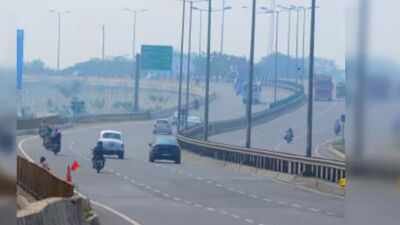
NEW DELHI: Barely 8% of the country’s 1.46 lakh km national highway (NH) network is now less than two lanes wide, compared with 2018-19, when such stretches accounted for nearly one-fourth of the network. Data shows the length of less-than-two-lane NHs has shrunk by 64% over the past nine years to around 13,000 km.In contrast, the length of high speed corridors (HSCs) has expanded more than 12-fold, while highways with four or more lanes have grown 1.5 times.
Share your thoughts in the comments
Be respectful · TOI community guidelines
Officials said the focus of highway development has increasingly shifted towards HSCs, greenfield access-controlled corridors and expressways. As these corridors are at least four lanes wide, their share in the overall NH network is expected to rise further. They said this would facilitate faster movement of passengers and freight while reducing logistics costs.However, despite the push for wider and seamless road connectivity, the average speed of trucks and the distance they cover each day remain well below global benchmarks. A truck in India typically covers only 300-350 km a day, compared with 700-800 km in the US and around 550-650 km in China.Officials said a comparison of truck speeds on two parallel highways illustrates the advantage of access-controlled corridors. On the Ahmedabad-Vadodara Expressway, trucks were found to travel at an average speed of around 80 kmph, compared with about 52 kmph on the parallel NH-64. The study also found that daily truck traffic on the expressway is nearly double that on the existing national highway.People aware of the govt’s plan to go for more HSCs said that the target is to build around 51,000 km of such network in the next 10 years, including the corridors developed or to be built by state govts.

✍️ Vikrant Kharwar
Vikrant Kharwar is the Founder and Editor of News Us Media. He writes about trending news, sports, entertainment, technology, and viral stories. His goal is to make news simple, informative, and easy to understand for readers across the United States and around the world.