








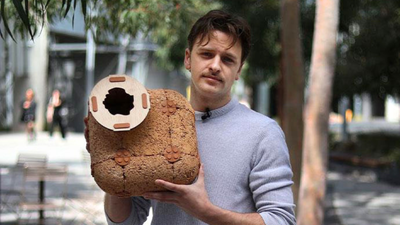
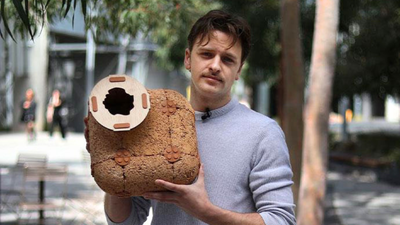
Australian designer Xavier Earls has developed Bush Cradle, a modular wildlife habitat system made from hempcrete tiles that mimic natural shelters such as tree hollows, fallen logs and rocky crevices. The system is designed to help conservationists create customised refuges for native animals facing habitat loss. Its four interlocking tile designs can be assembled into different configurations, including tree hollows and ground dens, with entrances tailored to individual species. The project aims to address the shortage of natural shelter for wildlife, including eastern quolls and ringtail possums. In an encouraging early observation, ringtail possums reportedly used a prototype overnight, offering an initial indication of the design’s potential.
How hempcrete tiles recreate tree hollows and rocky crevices
Bush Cradle uses four tile shapes connected through a slot-and-pin mechanism, allowing shelters to be assembled, dismantled and rearranged by hand without conventional tools. This makes it possible to adapt their configurations to different species and environments.The tiles are made from fibrous hempcrete, chosen for its insulating properties. Their manufacture combines 3D printing and casting, with lightweight printed frames placed inside moulds before hempcrete is poured in and left to cure. Laser-cut wooden entrance pieces allow openings to be customised for different animals.According to Earls’ project description, the developed tiles weigh approximately 200 grams each, compared with early prototypes that weighed more than one kilogram. The modular design also allows individual components to be repaired or replaced without discarding an entire shelter.
Why Australia’s wildlife needs alternative shelters
Natural features such as tree hollows, fallen logs and rocky crevices provide essential places for animals to rest, nest, hide from predators and raise their young. However, land clearing, development and habitat degradation are reducing the availability of these refuges.Tree hollows are particularly important for many native species, but they can take hundreds of years to form naturally. When mature trees disappear, the animals that depend on their hollows can lose essential shelter long before replacement habitats develop.Bush Cradle offers a potential way to bridge this gap by allowing conservationists to construct artificial refuges suited to particular species and landscapes. Its adaptable components provide an alternative to conventional nest boxes, which are often designed for a specific purpose.
Which animals could benefit from Bush Cradle?
The system is intended to accommodate different native Australian animals by allowing shelters to be tailored to their habitat requirements.Eastern quolls: These spotted, nocturnal marsupials use dens and other sheltered spaces. Bush Cradle can be configured to mimic hollow logs and ground refuges, with entrances and chambers adapted to their needs.Ringtail possums: These tree-dwelling marsupials need protected places to rest. A Bush Cradle prototype installed in a tree was reportedly occupied by wild ringtail possums overnight.Other native wildlife: Earls has identified potential applications for pygmy possums, reptiles, endangered skinks and microbats. Different configurations could accommodate their varying entrance sizes and shelter requirements.
Early field observations offer an encouraging sign
Trail-camera footage reportedly recorded ringtail possums using a Bush Cradle prototype installed in a tree overnight. The observation provided an early indication that the structure could serve as a usable refuge beyond the design studio.However, a single observation cannot establish whether the shelters improve long-term survival, breeding success or population recovery. Further monitoring would be needed to determine how consistently different species use the structures and how well they perform under varying weather conditions.
Who developed Bush Cradle?
Earls created Bush Cradle as his final-year industrial design project at Monash University in Australia. His work combines ecological research, digital modelling, 3D printing and material experimentation to explore how design could help address habitat loss.An internship at Reef Design Lab helped him explore how digital fabrication and casting could be combined to produce habitat structures. Earls now works full-time at the organisation, continuing to investigate how design can support ecosystems.Bush Cradle received a Best in Class Award in the Next Gen category at the 2026 Australian Good Design Awards, according to Monash University. The recognition highlighted the project’s approach to combining industrial design with wildlife conservation.
What comes next for the project?
Earls aims to establish a network of conservationists who can use Bush Cradle to create customised wildlife refuges in Australia and potentially elsewhere. The project has also attracted interest for possible use in restoring habitat for endangered skinks and microbats in mining-affected areas of northern Queensland.The long-term ambition is to make artificial habitat creation more accessible, allowing conservationists to respond to the requirements of different species rather than relying on a single shelter design.

✍️ Vikrant Kharwar
Vikrant Kharwar is the Founder and Editor of News Us Media. He writes about trending news, sports, entertainment, technology, and viral stories. His goal is to make news simple, informative, and easy to understand for readers across the United States and around the world.