






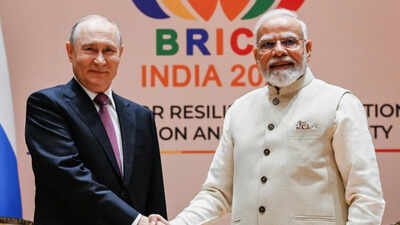
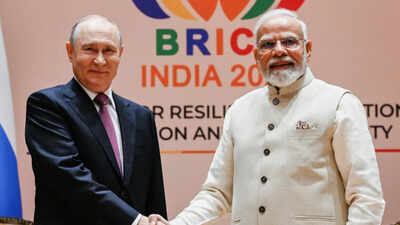
NEW DELHI: External affairs minister S Jaishankar has said Prime Minister Narendra Modi discussed the Ukraine conflict with Russian President Vladimir Putin in New Delhi and earlier in Bishkek, as India continues diplomatic engagement with Moscow, Kyiv and Washington on measures to protect civilian shipping, restore grain exports and safeguard energy infrastructure.Speaking exclusively to news agency ANI on the sidelines of the G20 Foreign Ministers’ Meeting in Atlanta on Saturday, Jaishankar said India had held discussions with Russia, Ukraine and European countries on three key aspects of the conflict.“Prime Minister himself had a discussion with President Putin in Delhi and before that in Bishkek,” he said, referring to India’s diplomatic engagement.Jaishankar said he had also discussed the conflict with Russian and Ukrainian officials, including during visits to Moscow and Kyiv, and in talks with Russian foreign minister Sergey Lavrov.“We have also been coordinating this with the Americans because they have their own peace mediation initiative. So Secretary Rubio knows properly what is going on here,” he said.
India focuses on civilian shipping, grain exports and energy security
Explaining the three areas under discussion, Jaishankar said India was first seeking to ensure that civilian vessels and seafarers were not targeted in the conflict.The second priority was to restore grain exports from Russia and Ukraine, both major suppliers to international markets. He said shipments through the Black Sea had fallen sharply because of the conflict.“One not to attack civilian shipping and seafarers. The second is to find a way by which the grain exports from both Russia and Ukraine. Then these are two major exporters of grains for the global markets. Find a way of restoring that flow because that flow has cut down very sharply in the Black Sea,” he said.The third area concerned energy infrastructure and shipments. Jaishankar said this was the most complicated issue because the concerns differed among the parties involved.“Non-attack on energy is probably the most complicated piece because it means different things to the different players,” he said, referring to refineries, electricity grids and ships carrying fuel.He added that India was trying to bring the parties together to address these concerns but could not publicly disclose the current status of the discussions.
Jaishankar calls for diplomatic solutions to global conflicts
At the G20 meeting, the external affairs minister reiterated India’s position that major international conflicts required diplomatic engagement rather than military escalation.“Look, there are big conflicts today, two major conflicts which are having global ramifications,” he said, adding that “there are no military solutions; we have to find a diplomatic pathway.”Jaishankar also flagged the impact of disruptions in energy markets and fuel distribution on developing economies.“This distortion of the energy markets, the politicisation of energy flows, this is something which is very harmful,” he said, adding that the Global South was bearing the brunt of energy shortages.He also raised concerns over disruptions to grain shipments through the Black Sea and fertiliser shortages linked to tensions along the Persian Gulf and Red Sea corridors.On supply chain resilience, which was the focus of the G20 meeting’s concluding plenary session, Jaishankar called for greater diversification of global production and manufacturing networks.“Today we need more diversified supply chains,” he said, advocating “more globalised, you know, more diversified production, more diversified manufacturing.”In a post on X after the session, he said securing resilient supply chains was central to the well-being of the global economy. He also called for promoting the “right to industrialise”, resisting “predatory practices” and pursuing the “de-politicisation of markets”.
Jaishankar meets Russian, Polish and South Korean counterparts
On the sidelines of the G20 meeting, Jaishankar held separate discussions with his Russian, Polish and South Korean counterparts on the Ukraine conflict, West Asia, bilateral ties and multilateral issues.After meeting Lavrov, Jaishankar said the two sides had discussed the Ukraine conflict, the Gulf situation and multilateral issues.He also met Polish Deputy Prime Minister and Foreign Minister Radoslaw Sikorski, with discussions focusing on the Ukraine conflict, India-European Union ties and the G20.“My meeting with DPM & FM Radosław Sikorski @sikorskiradek of Poland focused on the Ukraine conflict, India-EU ties and the G20,” Jaishankar said.Poland is participating in this year’s G20 meetings as a full participant following an invitation from the United States. It has also expressed interest in securing permanent membership of the grouping.
Share your thoughts in the comments
Be respectful · TOI community guidelines
Jaishankar separately met South Korean foreign minister Cho Hyun to review bilateral cooperation and discuss G20-related and other multilateral issues.“Appreciated the stocktaking with @FMChoHyun of the Republic of Korea of our bilateral cooperation, as also the discussion on G20 and multilateral issues,” he said.Earlier on Saturday, Jaishankar also participated in the Quad Foreign Ministers’ Meeting in Atlanta with US secretary of state Marco Rubio, Japanese foreign minister Toshimitsu Motegi and Australian foreign minister Penny Wong.The US is holding the G20 presidency this year. After two days of discussions, Jaishankar and other foreign ministers attended a college football game between the Florida Gators and the Georgia Bulldogs at the Mercedes-Benz Stadium in Atlanta.

✍️ Vikrant Kharwar
Vikrant Kharwar is the Founder and Editor of News Us Media. He writes about trending news, sports, entertainment, technology, and viral stories. His goal is to make news simple, informative, and easy to understand for readers across the United States and around the world.