








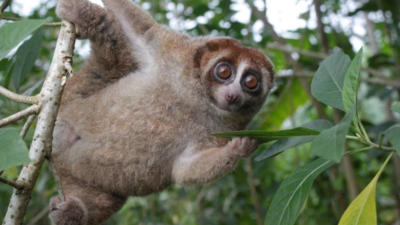
For decades, one of Indonesia’s rarest primates survived largely beyond the view of scientists. Now, a series of wildlife rescues on the island of Bangka has brought the elusive animal back into focus, offering fresh hope for a species once feared to have disappeared entirely. According to Reuters reporting by Will Dunham, a new study published in the journal Spixiana documents more than 90 Bangka slow lorises identified between 2015 and 2025. The findings, also highlighted by the Alobi Wildlife Rescue Center and conservation group Re:wild, suggest that the little-known primate has survived despite decades without reliable scientific records and continuing pressure on its habitat.
A rare primate emerges from decades of uncertainty
The Bangka slow loris, scientifically known as Nycticebus bancanus, lives on Bangka, an Indonesian island off the southeastern coast of Sumatra. Small, nocturnal and adapted to life in trees, it has reddish-brown fur, distinctive facial markings and large eyes that help it navigate the forest after dark.The species was last documented in historical scientific records from around 1930 to 1932. With little reliable information available for decades, its continued existence became uncertain. In 2020, the International Union for Conservation of Nature classified the Bangka slow loris as Critically Endangered and possibly extinct. Conservation organisation Re:wild also included it among its lost primates, species that had not been reliably documented for an extended period.The recent findings change that picture. Between 2015 and 2025, the Alobi Wildlife Rescue Center encountered more than 90 individuals from different locations across Bangka, indicating that the species has persisted in multiple parts of the island. The discoveries do not establish the total population or prove that the species is secure. They do, however, provide researchers with a starting point for understanding where the animals survive and what protection they need.
How wildlife rescues helped bring the species to light
Many of the slow lorises were discovered after being found in houses, gardens, plantations or near roads. Some had suffered serious injuries, including damage caused by electrical wires. The rescue centre documented the animals while providing care, helping researchers gather information about a species that has received remarkably little scientific attention. Of the more than 90 individuals identified, 86 recovered sufficiently to be released into suitable natural habitats.The releases represent an important conservation milestone, but they are only one part of the effort needed to protect the species. Without reliable information about population size, distribution and breeding, researchers cannot yet determine how well the remaining population is faring in the wild. The new study also illustrates the role rescue organisations can play in documenting threatened wildlife, particularly when animals are encountered outside protected forests.
A venomous primate facing habitat loss
Slow lorises are unusual among mammals because they produce venom. Specialised glands near their elbows release a secretion that the animals combine with saliva before delivering it through a bite. The venom can cause severe allergic reactions in humans and is believed to play a role in conflicts between lorises, as well as defence against potential threats.Despite their distinctive biology, the animals are vulnerable to habitat destruction. On Bangka, tin mining and the expansion of oil palm plantations have reduced natural forest cover, threatening the places where the primates feed, shelter and move through the trees. Their slow, cautious movements and nocturnal habits can also make them difficult to study in dense forest, contributing to gaps in scientific knowledge.Protecting the remaining woodland is therefore central to the species’ future. Researchers say systematic field surveys are needed to establish how many Bangka slow lorises remain, identify the areas where they persist and assess the condition of their habitats.
Rediscovery brings hope, but not a guarantee
The return of the Bangka slow loris to scientific attention highlights an important distinction in conservation: a species that has gone undocumented is not necessarily extinct, but rediscovery does not mean it is safe from extinction. The latest findings offer an opportunity to move beyond rescue and release towards a more comprehensive conservation strategy, combining habitat protection, population surveys and continued monitoring.For a primate that remained scientifically elusive for nearly a century, finding more than 90 individuals is a significant step. Whether that discovery leads to lasting recovery will depend on protecting the forests they inhabit and ensuring that the animals can survive there for generations to come.

✍️ Vikrant Kharwar
Vikrant Kharwar is the Founder and Editor of News Us Media. He writes about trending news, sports, entertainment, technology, and viral stories. His goal is to make news simple, informative, and easy to understand for readers across the United States and around the world.