









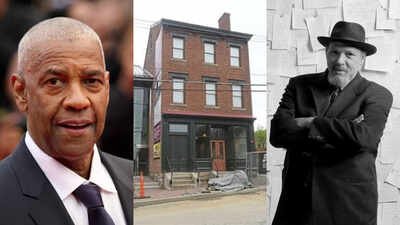
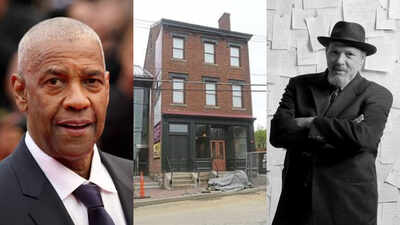
Some houses preserve memories, while others hold the beginnings of stories that eventually shape generations. In Pittsburgh’s historic Hill District, a modest childhood home has become a lasting tribute to one of America’s most celebrated playwrights, August Wilson. Once deteriorating and at risk of being lost, the property where Wilson spent his formative years has been transformed into a 6,000-square-foot arts and community centre. The restoration, supported by a fundraising campaign led by Hollywood actor Denzel Washington, has given the building a renewed purpose while preserving the surroundings that influenced Wilson’s celebrated body of work. Scroll down to read the details.
A childhood home saved from decay
According to Architectural Digest, Washington spearheaded a $5 million fundraising initiative in September 2018 to support the restoration of Wilson’s childhood home in Pittsburgh, Pennsylvania. The Oscar-winning actor, who directed and starred in the 2016 film adaptation of Wilson’s play Fences, was among the prominent supporters who helped mobilise resources for the project.Other contributors included Oprah Winfrey, Tyler Perry, Shonda Rhimes, Spike Lee and Samuel L. Jackson, with Winfrey and Perry each contributing $1 million.Wilson, born Frederick August Kittel Jr., lived in the Bedford Avenue property with his mother, Daisy, and five siblings from 1945 to 1958. The neighbourhood, known as the Hill District, would later become an important influence on his writing, providing the cultural and social backdrop for much of his work, the Architectural Digest report adds.However, by the early 2000s, the building had fallen into disrepair. According to the Pittsburgh Post-Gazette, Wilson’s nephew, Paul Ellis, purchased the property shortly before the playwright’s death in 2005, hoping to preserve it. Together with architect Rob Pfaffmann, he established the nonprofit Daisy Wilson Artist Community to oversee its restoration.
From a deteriorating building to a cultural destination
The preservation process involved several years of planning and structural work. The property received Pittsburgh historic landmark status in 2008, followed by emergency stabilisation efforts between 2010 and 2016. It was also added to the National Register of Historic Places in 2013.The $5 million fundraising campaign launched in 2018 enabled the larger restoration to move forward. Although the project was initially expected to finish in 2020, the pandemic caused delays. The restored property eventually reopened in August 2022.The 6,000-square-foot complex brings together the original 1840s house, an upstairs expansion dating to the 1880s and a contemporary addition. The newer section incorporates elevators, ensuring accessibility throughout the building while allowing its historic architectural elements to remain visible.
Preserving Wilson’s legacy through the arts
Rather than functioning solely as a conventional museum, August Wilson House was designed as an active cultural and community space. The Pittsburgh Post-Gazette reported that Wilson had wanted his childhood home to remain useful, particularly as a place that could support artists and creative expression.The centre includes four studios for artistic programmes, workshops, reading sessions and discussions. Two indoor galleries will showcase rotating exhibitions, while a rooftop terrace provides space for live performances overlooking Pittsburgh’s skyline.Outside, a landscaped garden and outdoor theatre offer opportunities for productions of Wilson’s celebrated American Century Cycle, a collection of ten plays exploring African-American experiences across different decades of the 20th century.
Inside the rooms where the playwright grew up
One of the most significant sections of the restoration is the preserved upstairs apartment where Wilson spent his childhood. The living room, kitchen, and bedrooms have been meticulously restored to match the family’s original surroundings.Details include replica wallpaper based on recollections from Wilson’s sister, vintage kitchen appliances and photographic displays featuring images of the Hill District. Restoration workers also uncovered personal artefacts, including shoes concealed inside the walls, believed to have been placed there for good luck.The project concludes by honoring the playwright and his neighborhood. With its combination of preserved domestic spaces, contemporary architecture and creative facilities, August Wilson House offers visitors an opportunity to experience the roots of his storytelling while giving future generations of artists a place to develop their own voices.Images Courtesy: Wikipedia, Facebook, and Pittsburgh Post-Gazette

✍️ Vikrant Kharwar
Vikrant Kharwar is the Founder and Editor of News Us Media. He writes about trending news, sports, entertainment, technology, and viral stories. His goal is to make news simple, informative, and easy to understand for readers across the United States and around the world.