











There have been copious amounts of chatter on social media and many column inches devoted in newspapers discussing how the ODIs in New Zealand could act as a dress rehearsal for the 2027 World Cup in South Africa, Zimbabwe and Namibia.Many feel the conditions in New Zealand mirror those that India may encounter in southern Africa this time next year. Judging by the bounce and movement that one saw in Auckland and Wellington in the first two ODIs, the argument may not be too far away from the truth. The Indian team management, though, may have stumbled upon an uncomfortable truth.Their best No. 5 batter features in the XI, but he is not batting there.For far too long in his 12-year international career, KL Rahul has been seen as Indian cricket’s utility man. Someone who can fill gaps rather than command a role. He has opened, batted in the middle order, kept wickets, played as a finisher and even served as a stop-gap solution whenever injuries or team combinations demanded adjustment. In many ways, he has been used as India’s “spare tyre”. Someone who is always available when needed but rarely afforded the security other batters enjoy.The irony is that whenever Rahul has been handed a clearly defined role, he has thrived. Let’s take Test cricket. He was shuffled around for years until Gautam Gambhir’s management backed him as a specialist opener from the 2024-2025 Border Gavaskar Trophy. The result was immediate. With clarity came consistency; Rahul’s numbers improved significantly.But they now face a similar decision in ODI cricket. The first two ODIs against New Zealand reinforced why Rahul may be better suited to No. 5 than No. 6, especially outside the subcontinent. In Auckland, India’s middle-order wobbled after Virat Kohli’s dismissal. In Wellington, the collapse was even more pronounced as Kohli departed early and India slid to 113/7 in pursuit of just 135 before rain and DLS came to their rescue.These weren’t conditions where batters with brute force and adventures with match-ups and left-right combinations were needed. The ball seamed, there was variable bounce and prodigious movement throughout the innings. These were conditions where batters had to silence their ego and rely on an organised technique to survive and take the team home.Rahul’s value lies there. Shreyas Iyer and Rahul were India’s most convincing batters in Wellington because they could absorb pressure. Rahul’s unbeaten 26 will not feature in his CV, but it was the innings India needed most.Axar Patel, by contrast, never looked comfortable. Twice in this series he has been promoted to No. 5, and twice he has struggled to make an impact. The role made sense in India and in the Champions Trophy in UAE and the 2024 T20 World Cup, where wickets were slower, as he could hit spinners and break up a bunch of righthanders. It looks far less convincing on pitches offering assistance to fast bowlers.
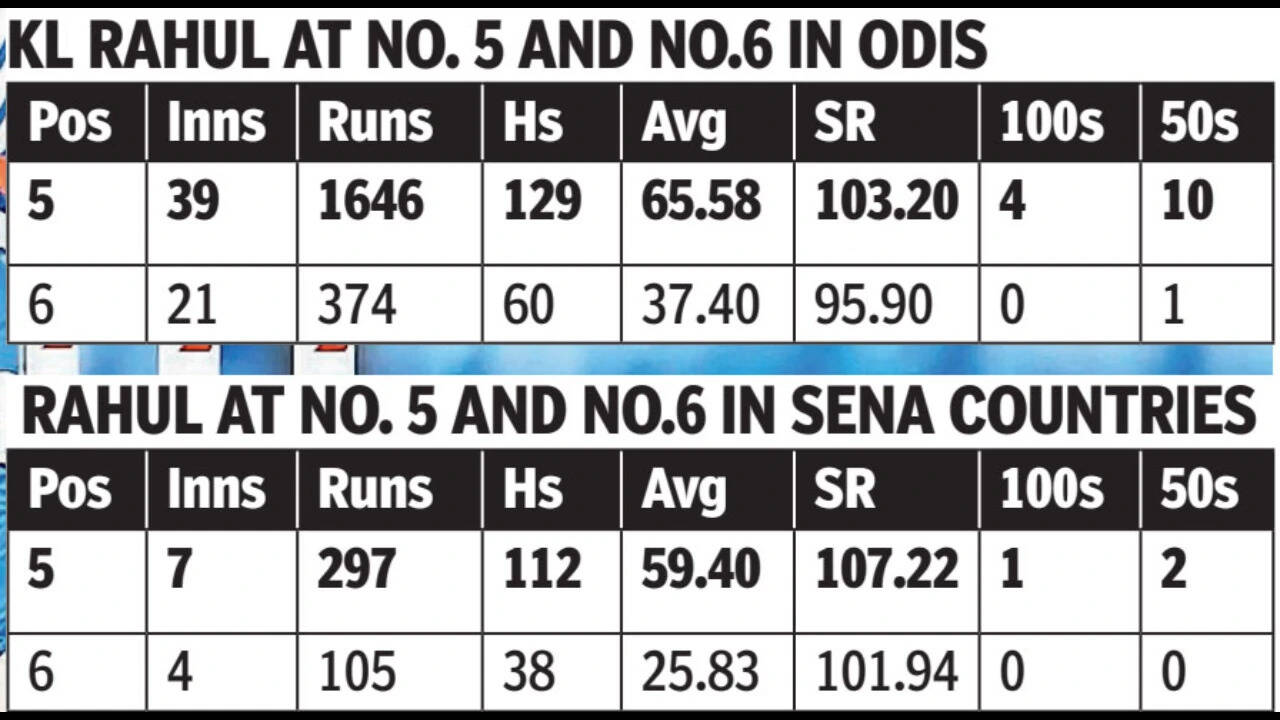
The numbers prove the point.Rahul has scored 1,646 runs in ODIs at No. 5 at an average of 68.58 with a strike rate exceeding 103. Axar averages 30.41 in the position. Overseas, Axar’s average falls to under 20.One understands why the team management likes the idea of Axar as a floater. It happened in the Rahul Dravid and Rohit Sharma era too. India value a left-right combination to use the unequal dimensions of certain grounds. And, with Hardik Pandya unavailable to bat at No. 6, they need batting depth till No. 8. But in trying to compensate for Hardik’s absence, are India compromising another position? If Hardik at No. 6 and Rahul at No. 5 is the World Cup blueprint, why wait until 2027 to implement it?The World Cup will be played in South Africa, Zimbabwe and Namibia, countries where early starts, fresh pitches and quality seam bowling will place the middle-order under relentless scrutiny. Their technique will trump theories.India should be using this period to give Rahul ownership of the role rather than treating him as a floating solution. Despite Axar’s whiteball skills being on the wane lately, he remains a valued asset. However, his optimum use could be lower down the order where his finishing ability and left-arm spin provide balance. Why burden him with the responsibility of rebuilding an innings in the event of a top-order collapse?Rahul has adapted to what the team needed for far too long. Perhaps it is time the team adapts to what Rahul does best.

✍️ Vikrant Kharwar
Vikrant Kharwar is the Founder and Editor of News Us Media. He writes about trending news, sports, entertainment, technology, and viral stories. His goal is to make news simple, informative, and easy to understand for readers across the United States and around the world.