







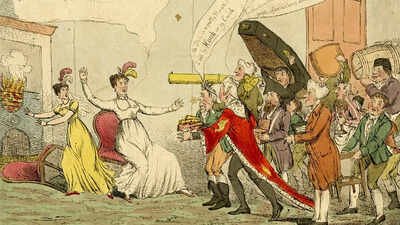
Authors are perhaps the most notorious of all professions. They spend half their lives surrounded by books and playing with words, yet can sometimes be the most mischievous of them all. And someone in London got a good taste of it two centuries ago.An account published in Jackson’s Oxford Journal on December 1, 1810, described how an unusual procession of visitors and deliveries brought Berners Street to a standstill. What began with a few unexpected callers soon turned into a spectacle involving tradesmen, carriages, household goods and even prominent members of London society.The first knock on the door came early in the morning. A chimney sweep had arrived at a house on Berners Street, London, claiming that he had been summoned to clean its chimneys. The maid who answered the door knew nothing about it and sent him away. But he was not the last visitor. More chimney sweeps soon followed, and before long, carts carrying coal, furniture and other goods began crowding the street. The woman who lived at No. 54, Mrs Tottenham, had apparently ordered none of it.
The wager behind the chaos
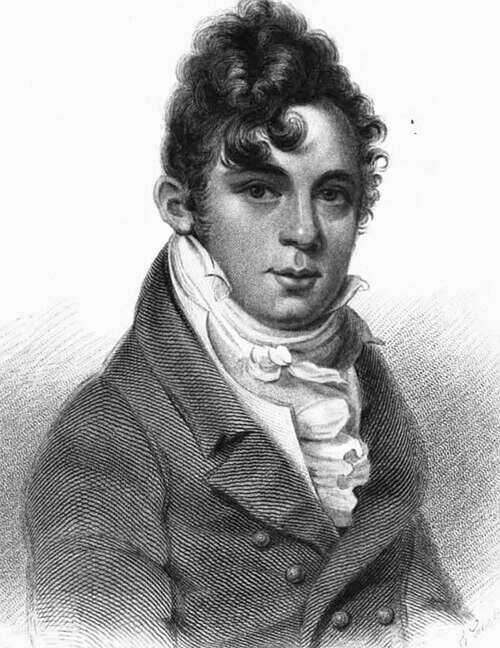
Portrait of Theodore Hook, the hoax’s perpetrator (Wikimedia Commons)
Theodore Hook was an English writer, composer and wit known for his elaborate practical jokes. According to later accounts, Hook made a wager with his friend, architect Samuel Beazley, that he could turn an ordinary house into London’s most talked-about address. His chosen target was No. 54 Berners Street, the home of a woman identified in historical accounts as Mrs Tottenham.Once, while Hook was taking a walk through the streets of London with his friend, he looked at a rather modest-looking house at No. 54. On the spot, he wagered a guinea that he could turn the modest household into the most recognised house in London within a week, and his friend Beazley accepted the challenge.What followed was a chain of events that unfolded over the following days. Hook wrote and sent hundreds of letters to tradesmen, merchants and even prominent individuals across London. The requests were all made in the name of the house’s unsuspecting resident, Lady Tottenham. Some were asked to deliver household goods, while others were asked to provide services or attend to supposed emergencies. Each recipient had been given a reason to believe that the request was genuine, and many were expected to arrive at the same address on the same morning.The plan became even more elaborate when influential figures, including the Lord Mayor of London, were drawn into it. He was reportedly asked to visit the house after receiving a message suggesting that the woman living there was unable to attend an official summons. Other prominent visitors were drawn in through similarly fabricated messages, turning what might have been a series of confusing deliveries into a spectacle involving some of the city’s most recognisable public figures.The wager was not simply to attract a crowd but to make an otherwise unremarkable household impossible to ignore.
The aftermath of the Berners Street hoax
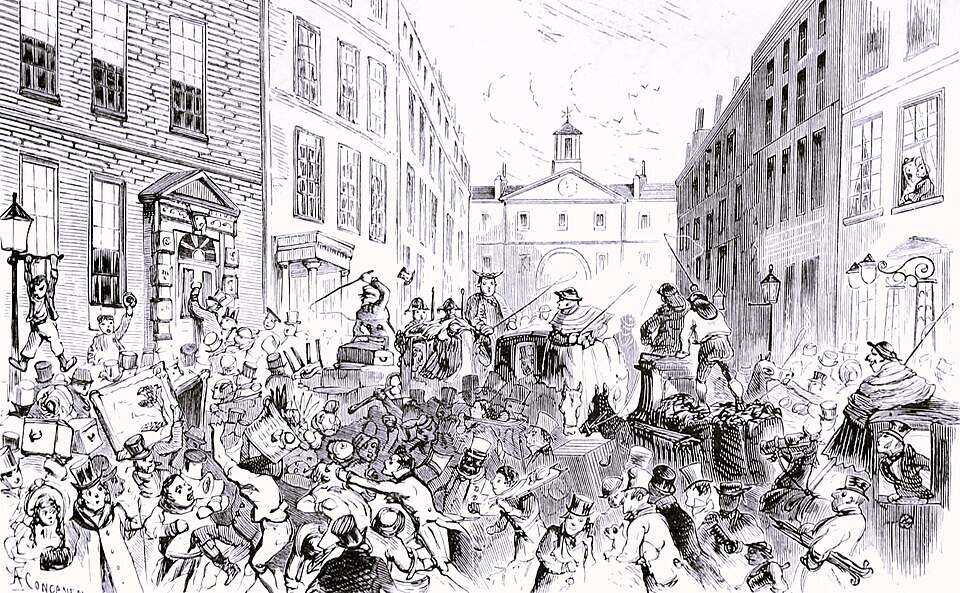
Illustration of the hoax (Wikimedia Commons)
The incident quickly became more than an afternoon of confusion on Berners Street. It attracted considerable attention in the London press, with the scale of the deception becoming a subject of public fascination. But not everyone found the episode amusing. The London Annual Register described it as a “malignant species of wit”, reflecting the criticism that an unsuspecting woman had been made the target of an elaborate practical joke.The identity of the person behind the hoax was not immediately established. Theodore Hook, however, emerged as a suspect in the years that followed. By 1812, The Satirist was already reporting suspicions about his involvement. Hook later appeared to claim responsibility through a character in his semi-autobiographical work Gilbert Gurney, published in 1835, in which the character declares: “I am the man — I did it!”The episode also outlived the newspaper coverage. By early 1811, references to the Berners Street hoax had begun appearing in theatrical performances, suggesting that the incident had entered London’s popular imagination. What had started as an elaborate deception at one private residence had become a subject of jokes and public entertainment across the city.More than two centuries later, the Berners Street hoax remains one of the most unusual episodes in London’s history of practical jokes. It offers us a glimpse into the curious lives of people before the age of memes and TikTok, when humour travelled through handwritten letters and elaborate schemes, sounding like an episode of your favourite sitcom. Long before viral posts and internet pranks became part of everyday entertainment, one writer had managed to turn an entire London street into an unwilling participant in his joke. Perhaps the tools of mischief have changed, but the human appetite for an elaborate prank has hardly disappeared.

✍️ Vikrant Kharwar
Vikrant Kharwar is the Founder and Editor of News Us Media. He writes about trending news, sports, entertainment, technology, and viral stories. His goal is to make news simple, informative, and easy to understand for readers across the United States and around the world.