









In 1953, Emma Gatewood tried hiking the Appalachian Trail, got lost and was rescued; two years later, at 67, she walked all 2,190 miles alone and made history

In 1953, Emma Gatewood tried hiking the Appalachian Trail, got lost and was rescued When park rangers found 65-year-old Emma Gatewood lost and confused in Maine in 1953 after she broke her glasses on the Appalachian Trail, they advised her to give up and return home. Two years later, at age 67, Gatewood returned to…

Read More

San Diego’s Leanne Fan, 18, built a device to simulate microgravity and tested red light on injured flatworms; tissue regeneration sped up by 95.2%, helping her win $80,000

Fan built her own $200 device instead of using NASA’s $50,000 clinostat. (Society for science photo) Leanne Fan, an 18-year-old student from San Diego, has been named a finalist in the 2026 Regeneron Science Talent Search for her research into wound healing in space. Her project looks at whether red light therapy can help wounds…

Read More

Meet Connor Hill, the 17-year-old Pennsylvania student who wrote a computer program to classify noble polyhedra; he proved there are 146 isolated examples and won $250,000

Connor Hill (Delta High School, State College, PA) By writing a custom computer algorithm that mapped every possible version of a rare class of geometric shapes, 17-year-old Connor Hill from Port Matilda, Pennsylvania, has won the top $250,000 prize at the 2026 Regeneron Science Talent Search.His computational proof classified a complex group of three-dimensional shapes…

Read More

China launches 24th batch of low-orbit internet satellites from Hainan site

The launch took place from the southern island province of Hainan. (Photo: Xinhua) China launched another batch of low-orbit internet satellites into space on Sunday, adding to its growing satellite network.The 24th group of the low-orbit internet satellites was carried aboard a Long March-12 rocket from a commercial spacecraft launch site in Hainan province.The rocket…

Read More

At 20, Finnish immigrant Maggie Walz arrived in Michigan with just $7; in 1903 she claimed 160 acres on a Lake Huron island and the colony she founded grew to five settlements with around 1,000 people

Maggie Walz Photo credit: National Park Service Born Margareeta Johanna Konttra Niiranen in Tornio, Finland, in 1861, Maggie Walz came to the United States at the age of 20 with almost nothing, just $7 in her pocket and a determination to build a new life. According to the National Park Service (NPS), Walz arrived in…

Read More

Fur traders introduced Arctic foxes across Alaska’s Aleutian Islands to produce pelts; by killing seabirds, the foxes helped turn lush grasslands into tundra

The foxes reduced seabird populations, which meant less nutrient-rich guano reached the islands. Arctic foxes introduced to more than 400 Alaskan islands for fur changed far more than the local wildlife. According to a study published in journal Science, by preying on seabirds, they disrupted the flow of nutrients from the ocean to land and…

Read More

In 1940, the Walker sisters sold their 122-acre Tennessee homestead for $4,750; a lifetime lease let them keep living there inside Great Smoky Mountains National Park

Deep in the heart of Great Smoky Mountains National Park, where mist clings to the ridges and the forest hums with life, stands a quiet log cabin. It is the home of the Walker sisters, six unmarried women who refused to leave their mountain home, even as the world changed around them. Their story is…

Read More

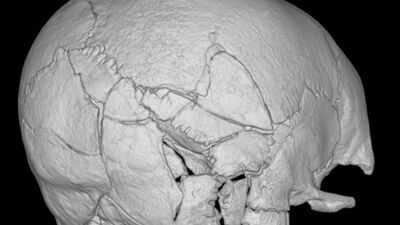
A skeleton found beneath Scotland’s Stirling Castle had more than 160 fractures; researchers say it is the first confirmed death from a trebuchet

The 14th century warrior’s skull was broken in 61 places. (University of Bradford photo) A skeleton uncovered beneath Scotland’s Stirling Castle may be the first confirmed archaeological evidence of a person killed by a trebuchet. Known to archaeologists as Skeleton 150, the remains belong to a defender who appears to have been killed during a…

Read More