









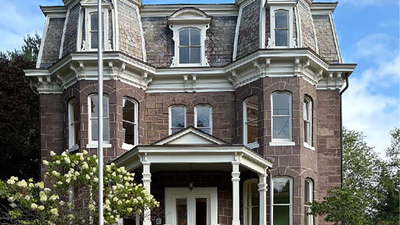
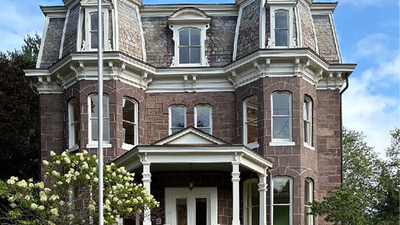
After more than a century as the home of the Hopewell Museum, a nearly 150-year-old house in Hopewell, New Jersey, is undergoing a $1.5 million restoration designed to preserve its historic character while preparing it for the future. According to a report in the Hopewell Express, the museum is now in the third phase of its multiyear “Reimagination” project at 28 E. Broad St. The work is restoring original features, including historic floors, windows and plasterwork, while adding modern systems to better protect the museum’s collections. The museum is expected to reopen in December 2026. The house was built in 1877 as the residence of Randolph Stout. As documented by the Hopewell Valley History Project, it became the home of the combined Hopewell library and museum in 1924, beginning a relationship with the institution that has lasted more than a century. A February report by Community News also detailed the third phase of the project, including interior restoration and upgrades to the building’s museum systems.
A museum hidden inside a historic home
The three-story brownstone was built in the Second Empire style, recognizable by its Mansard roof and projecting front bays. Before becoming a museum, it passed from the Stout family to Hugh A. Smith, who purchased it in 1906.The museum’s own history goes back to 1922, when the Hopewell Free Public Library and Museum Funding and Building Association was incorporated. The effort was prompted in part by a collection of antiques donated by Sarah D. Stout. Two years later, the Stout house was acquired for use by the library and museum. The library eventually moved elsewhere, leaving the building solely to the museum in the 1960s. But by 2018, decades of wear had become increasingly difficult to ignore. Floors, windows, pathways and mechanical systems all needed attention, leading to the larger restoration effort now underway.
The biggest surprise was underneath the carpet
One of the most intriguing discoveries came in 2021, when sections of the building’s old carpet were pulled back. Underneath was an ornate hardwood inlay.As more carpet was removed, additional 19th-century parquet flooring emerged across the building. The floors have since been cleaned, coated and buffed, allowing their geometric patterns to become part of the restored museum interior. The discovery is particularly fitting for a museum whose building is itself an important part of its history.
Even the windows had been frozen in time
Restoring the windows proved to be another painstaking job. The museum’s 13 double-hung windows had been sealed, nailed or otherwise immobilised over the years. Their original hardware and chains had also been painted over.Restoration specialist Chris Fullan of Forever Hung Windows in Pennsylvania dismantled the windows and repaired their historic components, including the mortise-and-tenon sashes and old hardware. The original wavy glass was carefully reset before the windows were returned to their places. Rather than making the house look brand new, workers have also preserved elements that reveal its age.Plaster walls and three fireplaces were restored, while some old cracks and irregularities were intentionally retained. On the third floor, new plaster was shaped around existing walls and alcoves instead of flattening away the building’s historic character.
Behind the old walls, a modern museum is taking shape
The $1.5 million third phase is not simply cosmetic. The project includes new electrical and plumbing systems, upgraded heating and air conditioning, improved climate control and museum-quality lighting. Old knob-and-tube wiring discovered inside the walls is being replaced with modern electrical infrastructure.New LED and track lighting will allow exhibits to be illuminated differently depending on whether they contain artifacts, photographs, maps or other materials. The museum is also being made more accessible, including an ADA-compliant lift providing first-floor access through the west entrance.
A collection spanning centuries
The renovated galleries will continue to showcase the history of Hopewell and the surrounding valley. The museum holds nearly 13,000 objects and artifacts, including Native American materials, tools, farm implements, furniture, textiles, china and glassware, photographs, maps, documents, Civil War artifacts and genealogical material.The first exhibition planned for the renovated galleries will bring objects from the collection together around a Hopewell Valley theme. The museum is currently closed to regular visitors but continues to offer scheduled research appointments from its temporary office at 43 Railroad Place. Its official website lists the reopening as late 2026, while the August 31 local report gives December as the expected target.When the doors finally reopen, visitors will see more than newly arranged exhibits. They will walk across floors laid down in the 19th century, look through painstakingly restored windows and move through rooms where traces of the old house have deliberately been left visible. After 102 years as a museum home, the building is becoming part of the exhibition all over again.

✍️ Vikrant Kharwar
Vikrant Kharwar is the Founder and Editor of News Us Media. He writes about trending news, sports, entertainment, technology, and viral stories. His goal is to make news simple, informative, and easy to understand for readers across the United States and around the world.