








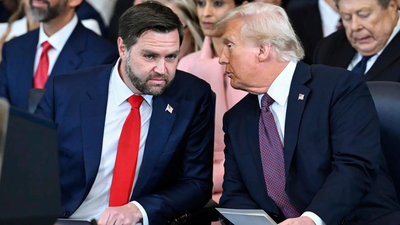
US Vice President JD Vance on Thursday said the Trump administration has several options for dealing with Iran, ranging from economic and diplomatic pressure to military and covert action, as the seven-month-old conflict between Washington and Tehran continues to escalate.Vance, speaking at a media briefing, said the administration would keep its plans private to preserve US President Donald Trump’s flexibility in deciding how to respond to Iran.“There are a lot of additional tools that we have at our disposal. Some of those the President will use and some of them he won’t,” Vance said.“But everything that could happen is on the table. Economic pressure, military pressure, diplomatic pressure, covert pressure. Of course these are tools in the President’s toolkit,” he added.The Vice President said Washington’s strategy was also driven by concerns over a potential global energy crisis, accusing Iran of continuing attacks on commercial shipping in the Strait of Hormuz.“We would have had an energy crisis because the Iranians refuse to stop acting like terrorists in the Strait of Hormuz,” Vance said, while defending US military operations aimed at protecting commercial vessels and keeping oil and gas supplies moving.Vance refused to outline what action Washington could take in the months ahead, saying the administration needed to retain the element of uncertainty.“Part of the reason they’re tools in the toolkit is because the Vice President, hopefully, is not dumb enough to stand up before all of you and a million Americans watching at home and say exactly what it is that we plan on doing,” Vance said.
Trump weighs war’s end
Vance’s comments come as the Trump administration appears to be weighing its next move in a conflict that has shown little sign of a durable settlement.A Wall Street Journal report said Trump is privately considering whether to declare the war over, with the US approaching midterm elections and energy prices remaining elevated because of the conflict. At the same time, the Pentagon has extended troop deployments in West Asia, suggesting the military confrontation could continue into next year.The uncertainty comes against the backdrop of renewed strikes. US Central Command said American forces had targeted multiple sites inside Iran, while Tehran launched attacks on US-linked facilities across the Gulf.Trump on Wednesday indicated that he expected the conflict to wind down soon, saying it would not continue for “very much longer”.Speaking to reporters at the Oval Office, Trump said US forces had carried out a “very heavy attack” on Iran the previous night, targeting military equipment recently deployed along the Strait of Hormuz, including radar and missile-related systems.“We hit them hard last night, very hard. They gave a little love tap, but we hit them very hard last night,” Trump said.
Beijing much more responsible than Tehran: Vance
Vance said China is “willing to play ball” with Washington’s efforts to economically isolate Iran, despite ongoing differences between the US and China.Asked whether the US-led “Operation Economic Outcast” could succeed without China’s cooperation, Vance said Beijing was “willing to play ball”.While acknowledging “some policy disagreements” and “misalignment of interests” with China, Vance said Beijing was “much more responsible” than Tehran.“Say what you will about them… they are not the sort of nation that shoots at commercial shipping because they’re not getting their way in an international dispute,” he said, referring to Iran’s attacks on commercial shipping.Vance clarified that China’s willingness to cooperate did not mean it was complying with every US request.
Economic pressure widens
The latest escalation also follows Washington’s launch of “Operation Economic Outcast”, a campaign unveiled by US treasury secretary Scott Bessent to intensify financial pressure on Tehran.Bessent also announced that EU has joined Trump’s aggressive decision to choke Iran economically.The operation focuses on sectors Washington considers critical to Iran’s economy, including oil, shipping, aviation and digital assets.The US treasury has said the campaign is intended to restrict Iran’s access to international financial networks and choke off revenue streams that Washington alleges support the Iranian government.

✍️ Vikrant Kharwar
Vikrant Kharwar is the Founder and Editor of News Us Media. He writes about trending news, sports, entertainment, technology, and viral stories. His goal is to make news simple, informative, and easy to understand for readers across the United States and around the world.