








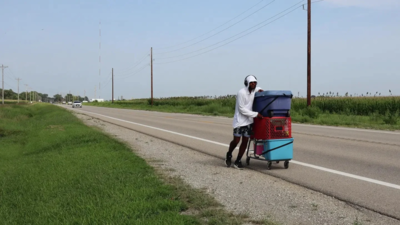
A 29-year-old man from New York has completed an extraordinary 2,500-mile journey across the United States, walking for 149 days while pushing shopping carts carrying his belongings. Chantz Rivera, who left his home in the Bronx on May 31, reached the San Francisco Bay Area on October 26 after travelling through 11 states, unfamiliar towns, highways and mountain ranges. Unlike conventional cross-country travellers, Rivera had no vehicle or fixed accommodation. He carried his essentials in a cart, slept in a roadside tent when necessary and documented his progress on social media. His decision to undertake the journey stemmed from a desire to escape the monotony of everyday life, explore unfamiliar places and experience a sense of freedom he felt was missing from his routine.
Why a New York man decided to walk 2,500 miles across the US
Rivera, who was born and raised in the Gun Hill Houses public housing complex in the Bronx, had spent most of his life in New York City. Before beginning the expedition, he had travelled outside the East Coast only twice, visiting Florida and Washington, DC, for short trips.He had worked various temporary jobs, including warehouse assignments arranged through shift-booking applications and washing dishes at a restaurant for approximately two years. However, he increasingly felt dissatisfied with his routine and uncertain about his future.He initially considered joining the US Army, hoping military service would allow him to travel, experience something different and earn a living. However, his attempt to enlist was unsuccessful. Rivera told The New York Times that a recruiter rejected his application because of his previous record, which included marijuana-related charges and misdemeanours.By April 2026, he was unemployed and looking for a way to change his circumstances. Rather than continue with the same routine, he decided to undertake something he had never imagined doing: walking across the country.“I just want to be free. I’m just walking because I’m using my free will. That’s it,” he told The New York Times while explaining his motivation.
How he prepared for the 2,500-mile journey
Rivera had approximately $500 to his name when he started preparing for the expedition. He spent much of it on basic equipment, including a tent, sleeping bag and backpack, which he filled with water, granola bars, peanut butter, portable chargers and first-aid supplies. He also carried bear spray and a machete for protection.His parents contributed another $250 towards the journey.Initially, Rivera planned to carry his belongings in his backpack, but the weight soon became difficult to manage. He therefore purchased a foldable grocery cart to transport his supplies while walking.However, his initial cart broke on the first day, forcing him to find a replacement. He subsequently went through several carts and wagons as their wheels and frames broke during the expedition. At different points, he used shopping carts obtained along the route.Interestingly, Rivera had never gone hiking or camping before undertaking the journey. He had to learn how to manage outdoor conditions, find suitable places to sleep and navigate unfamiliar roads as he travelled across the country.
Walking 15 to 30 miles every day across 11 states
Rivera began his journey on May 31, travelling west from the Bronx. He primarily followed US Routes 40 and 50, covering approximately 2,500 miles before reaching California.His route took him through New Jersey, Pennsylvania, West Virginia, Ohio, Indiana, Illinois, Missouri, Kansas, Colorado and Utah before he entered Nevada and California.He typically covered around 20 to 25 miles a day, although his daily distance varied between approximately 15 and 30 miles depending on the terrain, weather and availability of places to rest.The initial days were particularly difficult. Rivera experienced severe soreness, cramps and knee pain, and said he limped for approximately a week. He also considered abandoning the expedition during its early stages but eventually persuaded himself to continue.Pennsylvania presented particularly steep hills, while Ohio brought heavy rain. In Colorado, he had to push his loaded cart up long mountain inclines.His cart itself weighed approximately 50 pounds, according to his account to the San Francisco Standard, making steep climbs considerably more demanding.Accommodation was another challenge. When he could not find an affordable place to stay, he pitched his tent beside highways and roads. He occasionally received free motel accommodation from strangers who followed his journey online.He also had to navigate roads without proper pedestrian paths or pavements, sometimes walking along narrow shoulders dangerously close to passing vehicles.
Strangers offer food, accommodation and unexpected kindness
As Rivera documented his progress on social media, his journey began attracting attention across the country. His following eventually grew to approximately 60,000, while people started offering assistance as he travelled through different communities.Some strangers provided groceries, money and temporary accommodation, while others stopped to speak with him or helped him repair his shopping cart.In Indianapolis, a man named Donald spent an entire day showing Rivera around the city. He bought him groceries, arranged a haircut and attempted to repair his damaged cart.In Sacramento, a woman named Nikki surprised him with a cake. Other people offered him food, drinks, shoes and places to rest.A pastor in Ohio also helped him by arranging a lift to a motel, while residents in Indiana provided water, iced tea and other supplies.Rivera said he was particularly surprised by the generosity he encountered in smaller American communities. Although he had received warnings about racism and potentially hostile encounters, he told The New York Times that many people had welcomed and helped him.However, not every interaction was positive. In Cambridge, Ohio, a stranger offered to pay for a motel room but allegedly attempted to stay with Rivera afterwards, making him uncomfortable.
Police repeatedly question him about his shopping cart
Police encounters also became a recurring part of the journey. Rivera told The New York Times that officers and state troopers stopped him in almost every state, sometimes multiple times a day.Some officers wanted to establish whether he was safe, while others questioned why he was pushing a shopping cart along highways. On certain occasions, officers even drove him to another county or a road they considered safer for pedestrians.One particularly memorable encounter occurred in California, near Sausalito. An officer allegedly suspected that Rivera had taken his shopping cart from a nearby Safeway supermarket.Rivera explained that he had been walking across the country and showed the officer videos documenting his journey. The officer subsequently checked his identity and allowed him to continue.The encounter highlighted one of the unusual challenges of his expedition: although he was travelling with a clear destination and documenting his progress online, his shopping cart sometimes led people to assume he was homeless.Rivera said he was frustrated by such assumptions, particularly when accommodation providers appeared reluctant to accept someone travelling with a shopping cart.
Flooded path becomes his final obstacle before reaching California
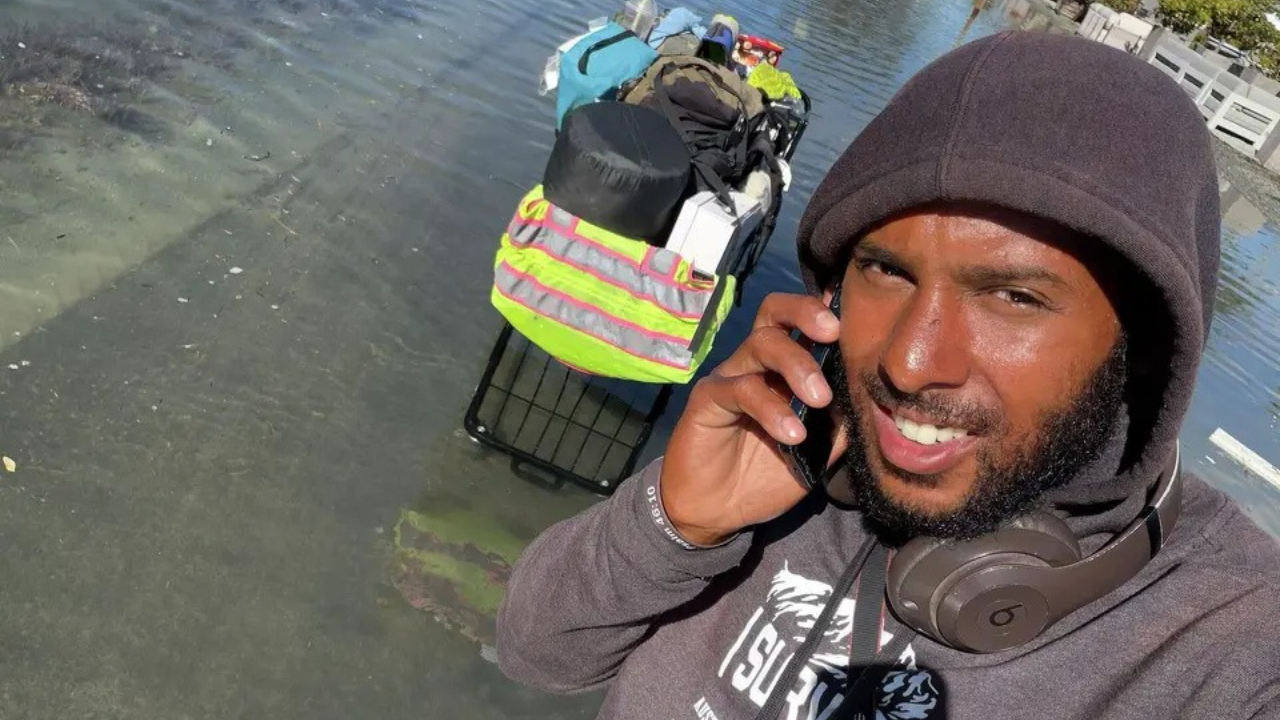
After travelling thousands of miles, Rivera encountered one last unexpected difficulty as he approached the San Francisco Bay Area.On October 26, he reached the Mill Valley and Sausalito area, where a flooded bicycle path forced him to push his cart through several inches of water. Recent storms had left parts of the route submerged, with water from the bay reaching close to Highway 101.Rivera described how the water continued getting deeper as he moved along the path. He eventually removed his shoes, rolled up his trousers and pushed his belongings through the water.Despite the unexpected obstacle, he continued towards his destination and reached the San Francisco Bay Area that evening.The journey had taken 149 days, beginning with a limited budget and little previous experience of long-distance walking or camping.By the time he arrived, Rivera had travelled through 11 states, experienced different landscapes and received assistance from strangers who had followed his progress.
His belongings are stolen shortly after reaching San Francisco
Rivera’s arrival did not bring an entirely smooth end to the adventure.After reaching San Francisco, he slept in Golden Gate Park before receiving two complimentary nights at a hotel to recover from the expedition.However, within hours of reaching the city, someone stole a bag containing his portable chargers and survival kit while he briefly left his shopping cart unattended at a McDonald’s on Fillmore Street.The missing bag also contained a memory card and flash drive holding photographs and videos documenting his five-month journey.Rivera told the San Francisco Standard that losing the recordings was particularly upsetting because they contained memories of experiences he could not recreate.Despite the incident, he said he felt relatively calm about the loss and was happy to have completed the expedition.
What does he plan to do next?
Having reached California, Rivera planned to spend some time exploring San Francisco before travelling to Los Angeles and Las Vegas. He eventually intended to return home to New York by plane.He also began considering another long-distance adventure, potentially walking across Europe. Although he acknowledged that language differences could create challenges, he appeared more confident about travelling to unfamiliar places after completing his American expedition.Rivera’s journey also attracted financial support through a crowdfunding campaign he launched in August after followers repeatedly asked how they could contribute. By the time he reached the Bay Area, he had reportedly raised more than $13,000, with subsequent reporting putting the total at nearly $16,000.He had even considered donating some of the money towards a free food event. Having completed the 149-day expedition, he said he felt freer than ever before.

✍️ Vikrant Kharwar
Vikrant Kharwar is the Founder and Editor of News Us Media. He writes about trending news, sports, entertainment, technology, and viral stories. His goal is to make news simple, informative, and easy to understand for readers across the United States and around the world.