









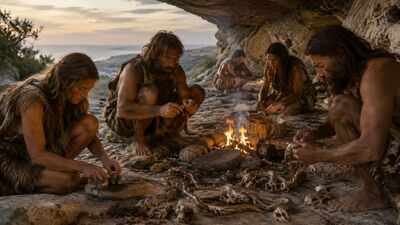
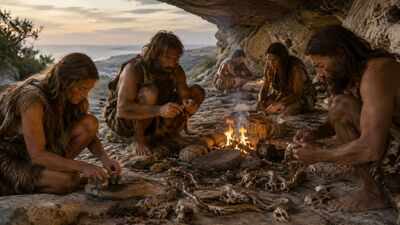
At a cave on the slopes of Mount Carmel, thousands of small reptile bones accumulated alongside the remains of animals hunted and gathered by people more than 11,000 years ago. For years, their presence raised a straightforward but difficult question: were the snakes and lizards food, or had they ended up there through the activity of predators?A closer examination of the bones offered an answer. At el-Wad Terrace, archaeologists identified marks and patterns of damage consistent with human handling and consumption. The evidence points to people in the region eating at least some of the reptiles, adding an unexpected detail to what is known about the diet of the Natufian communities who lived there.
3,000 snake and lizard bones found in ancient cave
The study, published in the journal Scientific Reports, titled ‘Squamate bone taphonomy: A new experimental framework and its application to the Natufian zooarchaeological record’ examined reptile bones from the 15,000-year-old el-Wad Terrace site in Israel, finding signs of trampling, erosion and breakage but little evidence of digestion.El-Wad Terrace was occupied during the late Pleistocene, with people using the site between roughly 15,000 and 11,500 years ago. Excavations have produced a dense collection of animal remains, including nearly 3,000 bones belonging to snakes and lizards.That is an unusually large share of the assemblage. Squamate remains the group that includes both snakes and lizards accounted for about a third of the animal bones recovered from the site.Most were vertebrae, which makes the archaeological evidence harder to interpret. Unlike the larger bones of deer or other hunted animals, these small pieces can be altered in several ways after an animal dies. Weathering, sediment, fire and the digestive systems of birds of prey can all leave marks on bone.So finding reptile bones near an ancient settlement does not, by itself, prove that people were eating them. The species represented at el-Wad included the European glass lizard, a legless reptile that can grow to a considerable size, as well as large whip snakes, eastern Montpellier snakes and Palestinian vipers. Smaller snakes and lizards were also present.
Ancient snake bones carried repeated marks linked to human handling
To separate human activity from other possible causes, the researchers carried out experiments using modern squamate bones. They exposed the bones to different processes that could have affected remains at an archaeological site, including weathering, burning, trampling and digestion by birds of prey.The resulting marks provided a set of comparisons for the ancient material. This mattered because the surface of a small reptile vertebra can change substantially after burial, potentially obscuring or resembling traces left during butchery. When the el-Wad bones were examined against those experimental patterns, some of the damage stood out.Several vertebrae from large whip snakes carried cut marks in similar positions. The marks occurred on different bones and, in some cases, appeared on the same side. That repeated pattern was difficult to explain as random damage after burial.
Bone damage showed which reptiles were likely eaten by ancient people
The case was strengthened by what was missing from many of the bones. Large whip snake and glass lizard remains generally did not show the digestion damage expected if birds of prey had swallowed the animals and later deposited their bones at the cave.That does not mean every reptile at the site was eaten. The archaeological record was more complicated than that.Some of the smaller snakes and lizards, along with many eastern Montpellier snakes and vipers, appear to have been brought into the cave by raptors or to have arrived through other natural processes. Their presence cannot simply be counted as evidence of human meals.The distinction is important. The study was not suggesting that Natufian people routinely consumed every snake and lizard represented in the excavation. Instead, the bone damage points to particular reptiles, especially large whip snakes and glass lizards having been used as food.
Reptiles reveal a wider Natufian diet before farming
The people who occupied el-Wad Terrace belonged to the Natufian culture, which emerged in the Levant towards the end of the Pleistocene. Their communities occupied an interesting point in human history.They were still largely dependent on hunting and gathering, but some groups were living in places for longer periods rather than moving constantly between temporary camps. This semi-sedentary way of life came before the widespread adoption of farming and permanent agricultural settlements.Their diet was varied. People gathered wild plant foods and hunted animals available in the surrounding landscape. The reptile remains suggest that smaller, less conventional sources of meat could also find their way onto the menu.Snakes and lizards would not necessarily have provided the same quantity of meat as larger game, but their remains show that the range of food being used by these communities was broader than the most obvious archaeological discoveries might suggest.

✍️ Vikrant Kharwar
Vikrant Kharwar is the Founder and Editor of News Us Media. He writes about trending news, sports, entertainment, technology, and viral stories. His goal is to make news simple, informative, and easy to understand for readers across the United States and around the world.