







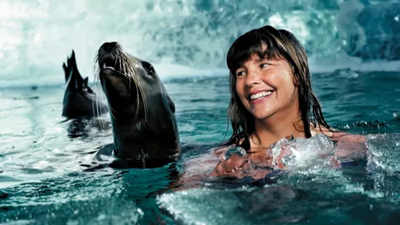
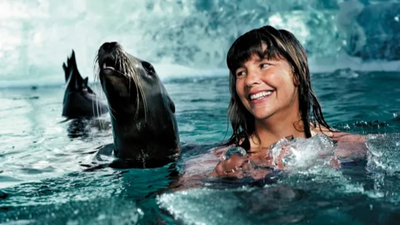
Fifteen years after setting a world record in the English Channel, 30-year-old American endurance swimmer Lynne Cox entered the 38°F (3.3°C) waters of the Bering Strait and completed a historic 2.7-mile swim from the United States to the Soviet Union. On 7 August 1987, Cox swam from Little Diomede Island in Alaska to Soviet-controlled Big Diomede Island. Her journey crossed the International Date Line and the heavily guarded border between the two Cold War superpowers. Records from the National Park Service (NPS) Shared Beringia Heritage Program document how the swim followed an 11-year effort by Cox to receive permission from Soviet leaders. Her arrival on Soviet territory became an important moment in US-Soviet relations. Soviet General Secretary Mikhail Gorbachev and US President Ronald Reagan later praised the achievement during their historic nuclear arms talks in Washington that year.
A record-breaking swimmer with a peaceful mission
Cox was born into a family of open-water swimmers. She learned to swim at a young age with her brother Dave, while her grandfather had also completed a swim across the Hudson River. At 15, Cox gained international attention by breaking the overall world record for the fastest English Channel crossing by a man or woman. Three years later, she became the first woman to swim across New Zealand’s Cook Strait. The 13.5-mile crossing took her through rough waters known for strong currents and sharks. Cox first came up with the idea of swimming across the Bering Strait in 1976. She wanted the journey to become a symbol of peace and show that ordinary people could build connections despite political tensions between the United States and Soviet Union. However, Cold War tensions made the plan difficult. Fundraising was challenging, and requests for permission from Soviet officials went unanswered for more than a decade. By 1987, Cox had paid much of the cost through her own savings and family support. Alaska Airlines also provided her with a free flight. She traveled to Little Diomede Island even though she did not yet have official permission to cross the border. Just 30 hours before the planned swim, tensions increased when two large Soviet naval ships moved into the middle of the strait. US fighter jets were then sent overhead. Permission finally arrived from Soviet leader Mikhail Gorbachev only 24 hours before Cox was scheduled to enter the water.
Swimming through freezing water and heavy fog
The approval also allowed local Inupiaq guides to accompany Cox in traditional skin boats. Their participation was significant because it was the first time in more than 40 years that residents of the islands were allowed to cross the maritime border to visit relatives on the other island. On the morning of 7 August 1987, Cox entered the freezing water in thick fog. The cold immediately placed enormous stress on her body. In interviews preserved by the National Park Service, Cox described the experience: “The cold was like a huge vampire pulling the heat from my body.” She said her fingers became grey from the extreme cold. Cox had only a magnetic compass to help guide her through the fog. Strong currents threatened to push her off course. Eventually, a Soviet support boat appeared and helped guide her toward the shore.An English-speaking Soviet journalist on the boat told Cox that an official reception group was waiting farther along the coast. Although she was suffering from severe hypothermia, Cox decided to continue swimming along the shoreline. She later explained that she wanted to reach the people waiting for her rather than simply touch the rocks and finish the crossing without making a human connection. As she approached the landing area, local residents and Soviet border guards gathered along the shore. For many of those watching, the moment was especially meaningful because the border between the islands had been closed for decades.
A historic welcome on Soviet soil
Cox completed the swim in two hours and five minutes. By the time she reached the shore, she was too weak to pull herself onto the rocks. Two Soviet military officers reached into the water and pulled her out. Cox later remembered the warmth of their hands and hearing them speak Russian. For her, the moment confirmed that the difficult journey had succeeded. A medical tent had been set up on the beach. Soviet doctor Dr. Rita Zakarova treated Cox for hypothermia using hot-water bottles, insulated sleeping bags and other warming methods. The swim then gained international attention.Later that year, during the December 1987 summit in Washington, D.C., where Reagan and Gorbachev signed the Intermediate-Range Nuclear Forces (INF) Treaty, the two leaders raised a toast to Cox.Gorbachev praised her achievement, saying:“She proved by her courage how close to each other our peoples live.”The crossing also contributed to greater cooperation between the two countries in the Bering Strait region. In 1990, US President George H.W. Bush and Gorbachev announced joint plans for international conservation efforts across the Bering Strait. These initiatives helped establish the foundation for what later became the NPS Shared Beringia Heritage Program. Cox went on to write several books about her swimming career. She continues to work as an author, educator and public speaker, focusing on subjects including risk management, endurance and teamwork. Her 1987 swim remains remembered not simply as an extraordinary feat of endurance, but as a rare moment when an athlete physically crossed one of the world’s most heavily guarded Cold War borders and helped demonstrate the possibility of connection between two divided nations.

✍️ Vikrant Kharwar
Vikrant Kharwar is the Founder and Editor of News Us Media. He writes about trending news, sports, entertainment, technology, and viral stories. His goal is to make news simple, informative, and easy to understand for readers across the United States and around the world.