








NEW DELHI: GST Council looks set to unveil a series of ambitious reforms that will cover the whole field of processes: from faster registration to easier refunds and input tax credit, resolving definitions for several services, ensuring that trucks in transit are stopped only for a reason and that too in origin or destination states, and mark a major push for decriminalisation.As part of GST 2.0, a detailed set of proposals – following eight rounds of working group meetings between Centre and states as well as three rounds of national coordination committee consultations and the resultant consensus – will be taken up by the Council headed by Union finance minister Nirmala Sitharaman on Wednesday.
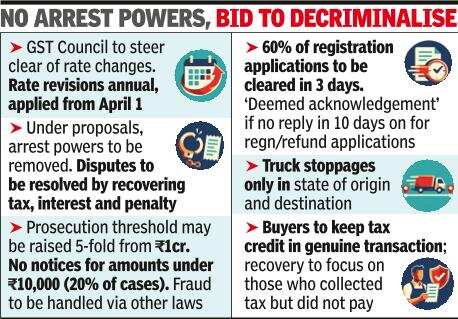
The message is clear: make life easier for businesses, particularly smaller ones, reduce discretion by use of technology, minimise litigation and ensure consumer benefits through lower transaction cost for trade. A system of deemed acknowledgement is being proposed where refund or registration applications will have to be mandatorily responded to within 10 days.
GST Council will steer clear of rate changes in this round
State govt officials are on board for the exercise which will help businesses and encourage growth,” said a person who has been part of the deliberations. Coming after last year’s rate cut, this is expected to be the biggest set of GST reforms. The council, not surprisingly, will steer clear of rate changes in this round, and will do away with periodic revisions and make the changes an annual affair to be applicable from April 1.Separately, Central Board of Indirect Taxes and Customs (CBIC) is also working on a framework that will make it easier for businesses with multiple offices across states to deal only with the central agency. The framework, which will be put out for public consultation, is part of a plan to slowly introduce a faceless system of audit, scrutiny and adjudication with Centre leading by example.For the moment, the ministers will focus on revamping processes at all four stages where business deals with tax officials at the Centre and in states: registration, filing returns and correcting them, claiming refunds and credit and dealing with demands.Decriminalisation and penalties The biggest proposed change is in doing away with the power to arrest, which rests with the court instead of officials, as is the case for some offences. The idea is to resolve disputes through civil consequences by recovering tax, interest and penalty. Fraud cases can be dealt with through other laws, an official said.Ministers will discuss taking nine offences and part of another one out of criminal law, softening of 24 offences and retaining 11. The threshold for prosecution may be raised from Rs 1 crore to Rs 5 crore.Sentencing is being reviewed to do away with minimum sentences, and in the middle band, the maximum is proposed to come down from three to two years. Ordinary penalties too are being reduced with late fees for small taxpayers likely to be waived.E-way billsWhile e-way bills emerged as a good tool for tracking goods movement, the idea is to put in place guardrails so that trucks are not stopped and drivers, who often do not know the details of consignments, are not harassed by tax officials. The plan is to allow for stoppage only in the state of origin and the destination, with strict rules. Besides accelerating transportation and reducing harassment, this will also help prevent damage to sensitive and fragile consignments, such as semiconductors.Registration The process is proposed to be simplified to ensure that 60% of applications are cleared within three days. The form is being revised to ensure that businesses don’t have to apply separately for each state that they operate in, and changes to the core field for change in directors, partners or address become smoother. Only a change in principal place of business will be examined, provided it was not done through the automatic route.Several technical grounds for suspending registration may be removed and suspension for things like not filing returns will be lifted if a taxpayer sets it right within a month.Closing the registration is also sought to be made easier, starting with small taxpayers, with the final proposed to be part of the closure application.Refunds Besides, GST Council will consider allowing refunds on plant and machinery, where credit often piles up for years. The move will benefit long-gestation projects such as semiconductors or refineries as they can get refunds, easing cash flow and reducing working capital requirement.Refund claims have to be acknowledged within 10 days or there will be deemed acknowledgement so that exporters get up to 90% of the refunds quickly.Officials have discussed re-engineering it to make it system-driven with data fetched from RBI, customs and zone systems and the claim acknowledged within 10 days, failing which it will be deemed to be acknowledged.Tax creditsA constant complaint for businesses is proposed to be addressed through an overhaul which will mean that in a genuine transaction, the buyer in the chain will keep the credit while the recovery will focus on the dishonest who collected the tax but did not pay. The move is expected to help SMEs and will address the biggest source of disputes.Some of the businesses that have been kept out of the chain such as outdoor catering, health and life insurance and telecom towers, are proposed to be brought back into the credit chain.In the case of businesses such as hotels or gyms, which often run on management contracts and face 5% GST without ITC at each stage, credit is now sought to be allowed, helping ease burden on customers.Services A new definition has been discussed, which will allow the supplier of service and the recipient to be the same person, making life simpler for exporters who work through branch offices. This will help avoid litigation for companies such as Infosys, which faced problems a few months ago.Similarly, testing, certification and similar services provided to overseas clients will now follow the location of the customer and will qualify as exports. Relief is likely for warehousing in free trade zones and ecommerce players, such as cab and delivery service providers, who will be given flexibility in deciding the model.Litigation No notices are likely for amounts under Rs 10,000, which account for nearly 20% of the cases. This will also apply to pending appeals and is expected to help SMEs. In cases where a taxpayer decides to pay instead of contesting a claim, the amount will be called a charge and not a penalty.The biggest relief will come through a proposal to allow a taxpayer to be heard before its ledger is blocked, denying it access to ITC.

✍️ Vikrant Kharwar
Vikrant Kharwar is the Founder and Editor of News Us Media. He writes about trending news, sports, entertainment, technology, and viral stories. His goal is to make news simple, informative, and easy to understand for readers across the United States and around the world.