








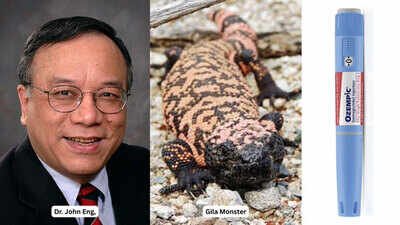

Long before Ozempic became one of the world’s most talked-about medicines, a doctor working at a Veterans Affairs hospital in the Bronx was studying something far less glamorous: the venom of a desert lizard.His name was Dr John Eng. In 1992, his research helped identify exendin-4, a molecule found in the venom of the Gila monster. That discovery eventually led to exenatide, sold as Byetta, the first GLP-1 receptor agonist approved for treating type 2 diabetes. The science behind that breakthrough would later help establish a drug pathway that transformed diabetes and obesity treatment.
The question hidden inside a lizard
The Gila monster, a venomous lizard found in the southwestern United States and northwestern Mexico, became an unlikely subject of medical research.Scientists had been studying GLP-1, a hormone produced in the human body that helps stimulate insulin release when blood glucose levels rise. But there was a major problem: natural GLP-1 breaks down very quickly, limiting its usefulness as a medicine.Eng and his collaborators isolated exendin-4 from Gila monster venom. The molecule acted on the same GLP-1 receptor but remained active far longer than natural GLP-1, making it a promising candidate for drug development.
A discovery that almost went nowhere
Eng worked at the James J. Peters VA Medical Center in the Bronx, where he treated patients while pursuing research into peptide hormones.After identifying exendin-4, the discovery faced a difficult journey towards becoming a medicine. Eng eventually licensed the technology to Amylin Pharmaceuticals, which developed a synthetic version of exendin-4 called exenatide.In 2005, the US Food and Drug Administration approved exenatide as a treatment for type 2 diabetes. Marketed as Byetta, it became the first approved GLP-1 receptor agonist and demonstrated that this biological pathway could be successfully turned into a medicine.
So, did John Eng discover Ozempic?
Not exactly.Ozempic contains semaglutide, a different GLP-1-based medicine developed by modifying the human GLP-1 hormone to make it last longer in the body. It is not made from Gila monster venom.But Eng’s discovery of exendin-4 and the success of exenatide were important milestones in demonstrating the medical potential of targeting the GLP-1 receptor. That broader scientific journey eventually contributed to the development of newer GLP-1 medicines, including semaglutide.
From an unusual experiment to a medical revolution
The story of John Eng is a reminder that major scientific breakthroughs do not always begin in famous laboratories or with obvious ideas.A molecule found in a venomous lizard helped researchers overcome one of the biggest challenges associated with GLP-1: finding a version that could remain active long enough to become a practical medicine.Today, GLP-1 medicines are changing the treatment of diabetes and obesity. But one important chapter of that story began decades earlier, when researchers looked at a slow-moving desert lizard and discovered that nature had already created a molecule scientists had been searching for.Disclaimer: This article is based on publicly available research, scientific literature and reports about Dr John Eng and the development of GLP-1-based medicines. TOI Education does not independently verify all historical accounts or research interpretations mentioned in the source material.

✍️ Vikrant Kharwar
Vikrant Kharwar is the Founder and Editor of News Us Media. He writes about trending news, sports, entertainment, technology, and viral stories. His goal is to make news simple, informative, and easy to understand for readers across the United States and around the world.