








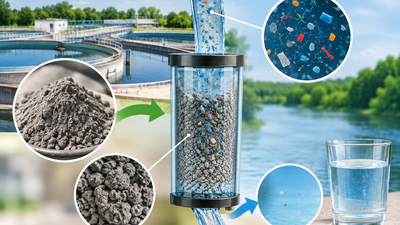
Microplastics are now found across aquatic environments, creating a difficult challenge for water-treatment systems that must remove tiny plastic particles without generating more waste. A new approach investigated in 2026 takes an unusual route: instead of treating water-treatment waste as something that simply needs to be discarded, researchers turned it into a material that could help filter microplastics from water. The idea links two environmental problems at once, waste generated during water treatment and persistent plastic pollution. In tests using real water rather than only laboratory-prepared samples, the resulting filter achieved removal efficiencies ranging from 86.9% to 97.1%, depending on the conditions and particles being treated. The findings suggest that material recovered from water-treatment processes could potentially be given a second use as part of a more circular approach to water purification.According to a study published in Water Research, researchers investigated the use of aluminum-based water-treatment residual (WTR), a material generated during the water-treatment process, as a low-cost filtering medium for microplastic removal. The work focused on whether this otherwise discarded material could be repurposed to capture plastic particles from contaminated water. The researchers tested the material under conditions designed to better represent real-world water, reporting microplastic removal efficiencies between 86.9% and 97.1%.
Turning waste into a filter
Water-treatment plants generate residual materials during the purification process. These residues can contain concentrated solids and other substances removed from raw water. Managing and disposing of them can add costs and create another environmental challenge. The new research explores whether some of this material can instead become a useful resource.The underlying idea is relatively straightforward. A filter needs a material with properties that allow unwanted particles to become trapped or retained as water passes through it. Instead of manufacturing an entirely new filtering material, researchers investigated whether treatment residuals could provide a suitable alternative. This approach fits into the broader concept of resource recovery, in which waste from one process is converted into an input for another. If the material can be used effectively, it could potentially reduce the amount of treatment waste requiring disposal while also providing a lower-cost option for microplastic filtration.
Why microplastics are difficult to remove
Microplastics are generally defined as plastic particles smaller than 5 millimetres, although they can be much smaller. Their size, shape, density and chemical composition can vary considerably. That variation makes their removal challenging. Some particles can be captured relatively easily by conventional treatment processes, while smaller particles may pass through certain filtration stages. Research has shown that existing drinking-water treatment processes can remove many microplastics because they are particles and can therefore be captured through processes such as coagulation, sedimentation and filtration. However, removal efficiency depends on the particles’ characteristics and the treatment system. A material capable of providing additional filtration could therefore serve as another barrier against microplastics.
Real water made the test more meaningful
One of the important aspects of the 2026 research is that the researchers did not rely solely on highly controlled laboratory water. Testing filtration materials with real water can be more complicated because natural water contains other substances that may interact with both the filter and microplastics. Organic matter, suspended solids and other contaminants can compete for available surfaces and potentially affect how efficiently plastic particles are captured. The reported removal range of 86.9% to 97.1% therefore provides evidence that the material retained substantial microplastic-removal capability under more realistic conditions. However, the figures should not be interpreted as meaning that the filter removes every type or size of microplastic with the same efficiency. Performance can vary according to particle characteristics, water composition and operating conditions.
A circular approach to water treatment
The method’s potential advantage extends beyond microplastic removal. Conventional filtration can create a waste stream of its own. Captured contaminants have to go somewhere, meaning that simply moving microplastics from water into another material does not eliminate the pollution problem. Any practical application would therefore need to consider how the used filter material is handled and whether the captured plastics can be safely contained or disposed of. That issue is particularly important because wastewater-treatment plants can remove large quantities of microplastics from water while transferring some of those particles into sludge or other residual materials. The new approach could nevertheless help move water treatment toward a more circular model: waste generated during treatment could become a resource for another treatment step.
What the research could mean
The findings do not mean that water-treatment waste can immediately replace established filtration technologies. The research is an experimental demonstration, and questions about long-term performance, filter lifespan, regeneration, contaminant accumulation, operating costs and safe disposal would need to be addressed before large-scale deployment. Still, the concept offers an intriguing combination of waste reduction and pollution control. Instead of viewing treatment residuals solely as waste, researchers are investigating whether their physical and chemical properties can be put to work. With real-water tests achieving 86.9% to 97.1% microplastic removal, the study points toward a potentially useful strategy: tackling two environmental problems with the same material. If further research confirms its durability, safety and economic viability, water-treatment waste could one day become part of the infrastructure designed to keep microplastics out of water in the first place.

✍️ Vikrant Kharwar
Vikrant Kharwar is the Founder and Editor of News Us Media. He writes about trending news, sports, entertainment, technology, and viral stories. His goal is to make news simple, informative, and easy to understand for readers across the United States and around the world.