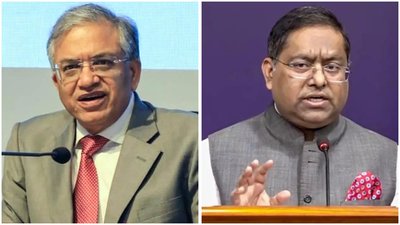









NEW DELHI: Rejecting what he described as the “myth” that “judges appoint judges”, Supreme Court Justice Dipankar Dutta said on Wednesday that the judiciary, in fact, plays “second fiddle” to the government in the appointment of judges.“This court is left to wonder why, even after the judiciary has been relegated to playing second fiddle to the executive in the matter of appointment of judges, is there still a clamour to induct an outsider at the stage of selection,” PTI quoted Justice Dipankar Datta as saying. According to the judge, the argument, coming from the executive, was a “feeble attempt to deflect attention from its own dereliction and failure”, rejecting the government’s attempt to draw a parallel with the absence of an “outsider” in the collegium system of judicial appointments.To underscore his “second fiddle” argument, Justice Dipankar Datta pointed to the government’s “selective” implementation of collegium resolutions, saying this undermines their sanctity. While acknowledging that the government approves a majority of the names recommended by the collegium, he noted that at least one is invariably withheld.“The sanctity of a collegium resolution is lost each time the executive implements it selectively, albeit approving the majority of those recommended while withholding at least one. Undeterred by such peaceful approvals and regardless of the fate of those not cleared by the executive, the collegium chooses to proceed seemingly to avoid a head-on conflict with the executive, and is left with the option to keep the institution running. The collegium thereby avoids a constitutional crisis,” Justice Datta said.On the “sweeping generalisation” that the collegium acts as a “law unto itself,” Justice Datta pointed to the detailed consultative process involved in judicial appointments, including the roles played by the central and state governments, intelligence agencies and other bodies in vetting credentials.He also noted that every appointment involves the formal — and final — approval of the President of India.“It has become fashionable nowadays to blame the collegium for every infelicitous choice, conveniently forgetting that aberrations are exceptions and not the norm, and that no system can guarantee infallibility of human choice. The uninitiated and the unversed unknowingly have thus been made to believe that the collegium of the Supreme Court and the collegium of the high courts comprise judges, who appoint judges,” Justice Datta stated.
Share your thoughts in the comments
Be respectful · TOI community guidelines
“Despite all its opacity and imperfections, the collegium system still remains the most viable option for safeguarding independence, as envisioned under Article 50 of the Constitution by its framers,” he added.Justice Datta made the observations in a split verdict delivered by a bench that also comprised Justice Satish Chandra Sharma.The bench was hearing a batch of petitions challenging the validity of a 2023 law that excludes the Chief Justice of India from the panel responsible for selecting the Chief Election Commissioner and other Election Commissioners.

✍️ Vikrant Kharwar
Vikrant Kharwar is the Founder and Editor of News Us Media. He writes about trending news, sports, entertainment, technology, and viral stories. His goal is to make news simple, informative, and easy to understand for readers across the United States and around the world.