











Indian equity benchmarks may have recovered from the lows they hit when the US-Iran conflict broke out but seven months after that the markets are still well below their record highs. Sensex and Nifty are under pressure as foreign investors continue to exit in quest for better and safer investment avenues amid global uncertainty.Foreign Portfolio Investors (FPIs) are selling again even as Domestic Institutional Investors (DIIs) remain net buyers. What is driving foreign investors to be cautious on India even as domestic investors continue to bet on the stock market?Sample this: FPIs have pulled out Rs 20,974 crore from Indian equities up till September 18 this month. The latest selling comes after foreign investors returned to Indian equities in July and August, investing Rs 20,200 crore and Rs 29,630 crore, respectively, according to CDSL data.With September’s outflows, FPIs have now pulled out nearly Rs 2.5 lakh crore from Indian equities so far in 2026, surpassing the just under Rs 1.7 lakh crore withdrawn during the whole of 2025.Net Systematic Investment Plans (SIPs) additions actually reached a six-month high in August. Net SIP inflow has risen 21% year-on-year to Rs 32,297 crore in August, staying in the Rs 31,000-32,000 crore range through FY27 so far.Total SIP inflows during April-August have reached Rs 1.6 lakh crore, up 15% year-on-year.The data clearly presents a two-way market: foreign investors have resumed selling amid global and macroeconomic concerns, while domestic investors continue to provide support through regular SIP investments, even as a growing number of investors discontinue or mature their SIPs.
Why FIIs are selling & DIIs are buying
Experts attribute more attractive investment options globally to India as the biggest reason for the selloff. Others note that the trend is not consistent and some months have also seen net inflows.VK Vijayakumar, Chief Investment Strategist, Geojit investments Limited tells TOI, “FIIs have the option to invest in many markets. DIIs and retail investors are focused on the Indian market. Valuations in the Indian market are not attractive enough for FIIs. More importantly, when the US bond yields are very attractive (10-year yield is at 5%) they will prefer this risk-free high return to the risky investment in Indian stocks.”He also cautions that it would be incorrect to say that FIIs are consistently reducing their exposure to Indian markets. While they were big sellers in 2025 and the first half of 2026, they turned buyers in India in July and August.So in August, FPIs invested $3.1billion, which is their strongest monthly inflow in nearly two years, while DII purchases increased to Rs 58,268 crore.The Federal Reserve has raised rates to 3.75-4%, narrowing the yield differential between India and the US and reducing the relative attractiveness of Indian assets.Brent crude has remained above $100 a barrel, while escalating tensions in West Asia have heightened concerns over inflation and India’s import bill.The rupee also declined, trading at a record low of 95.92-95.96 per US dollar and breaching the 96-mark intraday last week.According to Neeraj Gaurh, Director & Fund Manager, Anand Rathi AMC, FII selling is primarily driven by macro and global opportunity cost factors.First, FIIs are contending with elevated global bond yields and currency risk. A volatile rupee adds hedging costs and creates a psychological overhang for global allocators.Second, there has been a massive global concentration of capital into US AI infrastructure names and select North Asian markets (such as Korea and Japan).Furthermore, FIIs view Indian equity valuations, even after corrections, as elevated relative to other global emerging markets.Domestic investors and retail flows via systematic investment plans (SIPs) on the other hand are focused on underlying, long-term domestic fundamentals.“They are anchoring on a normalizing nominal GDP growth path of 10-10.5%, resilient manufacturing activity, and robust credit growth running at an 18% two-year high. DIIs recognize that this market is driven by earnings growth (projected in the double digits for FY27) rather than multiple expansion,” Neeraj Gaurh tells TOI.
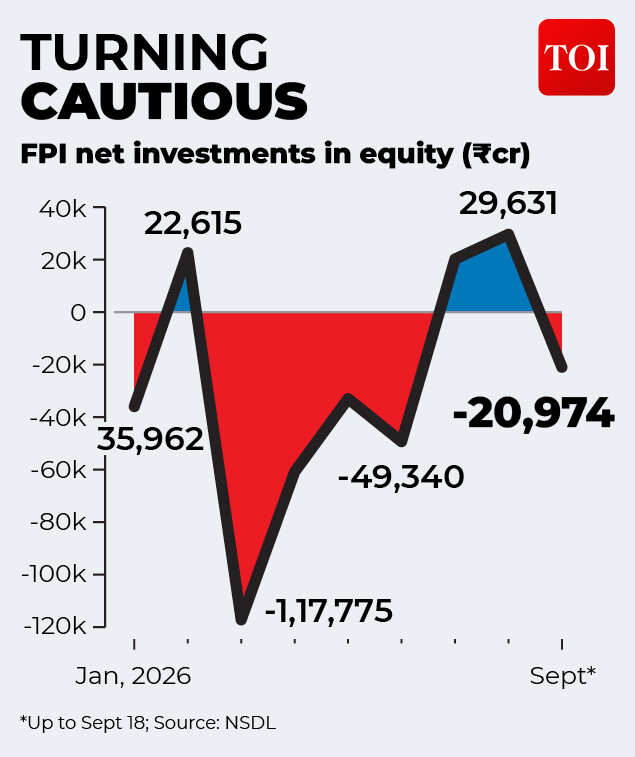
FPIs turn cautious
Who is right?
The answer isn’t straightforward since both are looking at the markets through fundamentally different lenses.Somil Mehta, Head of Retail Research at Mirae Asset Sharekhan notes that FIIs and domestic investors often have different investment objectives, time horizons and global opportunities.“FIIs tend to be more sensitive to global interest rates, currency movements, relative valuations and opportunities available in other markets. Their selling may therefore reflect global portfolio allocation decisions rather than a lack of confidence in India’s long-term growth prospects,” he explains.“On the other hand, DIIs and retail investors are supported by strong domestic liquidity and have greater exposure to India’s structural growth story. Domestic investors may therefore be more focused on the long-term potential of the Indian economy. At the same time, sustained domestic optimism should be balanced with a close watch on valuations and earnings growth,” he adds.Another trend that cannot be ignored is that FPI investment through the primary market has continued during September.
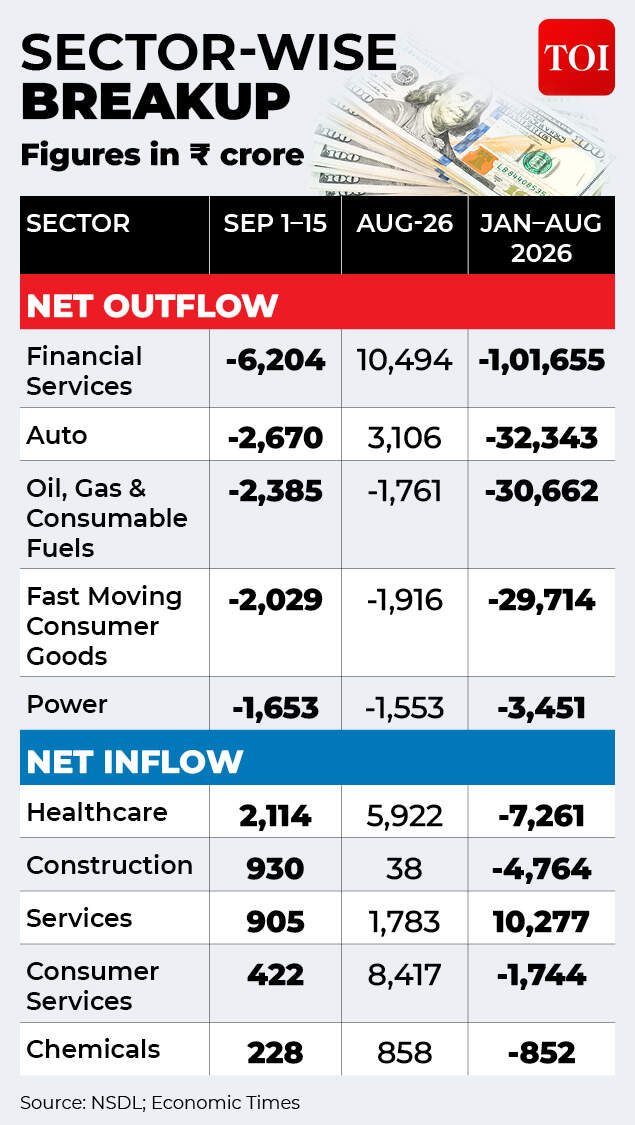
Sector-wise breakup of trends
What’s the road ahead?
Sustained domestic SIP flows have proven to be a resilient engine capable of keeping the market stable and preventing deep liquidity-driven crashes during foreign sell-offs.However, as Neeraj Gaurh of Anand Rathi AMC points out, while domestic buying absorbs supply, it primarily supports a market that compounds in line with double-digit earnings rather than driving sharp re-ratings or aggressive multiple expansion.“Valuation strain alone is unlikely to derail domestic flows, but a broader de-rating risk exists if macroeconomic variables deteriorate. If crude oil sustains a move above $90/bbl, it would stoke domestic inflation, strain marketing margins, and push global and local bond yields higher,” he says.“An unexpected spike in global yields or a prolonged period of earnings downgrades across sectors like IT, Airlines, or OMCs could eventually force domestic investors to moderate their return expectations and trim high-beta small-cap allocations in favor of large-cap quality,” he adds.Somil Mehta of Mirae Asset Sharekhan says that over the next 6–12 months, the performance of the Sensex and Nifty is likely to be influenced by corporate earnings, global interest rates, crude oil prices, foreign flows and geopolitical developments.“Volatility could remain elevated as these factors evolve, while the long-term growth outlook for India remains constructive. Rather than taking aggressive positions based on short-term market movements, investors should focus on quality companies with strong balance sheets, sustainable earnings growth and reasonable valuations,” he advises.
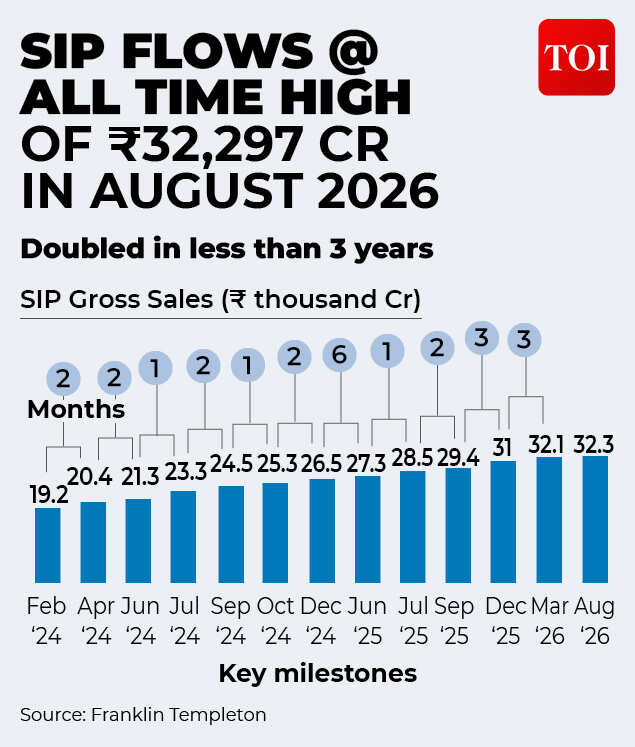
SIP flows at all time high in August 2026
A staggered investment approach, diversification across sectors and a long-term investment horizon can help investors navigate periods of market volatility, he adds.VK Vijayakumar predicts that when the US-Iran conflict ends, equity markets will rally.“A probable scenario is the conflict coming to an end around the midterm elections in the US in early November. If the conflict ends, it is a foregone conclusion that crude will drop sharply. This will help cool down inflation, improve India’s growth and earnings prospects facilitating a rally in the market,” he tells TOI.“Long-term investors with a 3 to 4 year time horizon can make lump sum investments in equities now. Fairly-valued large-caps have a favourable risk-reward ratio now. Investors with short-term investment horizons may opt for fixed income assets,” he says.Somil Mehta strikes a more cautious note: Strong domestic flows can provide meaningful support to Indian equities even when foreign investors remain net sellers. However, liquidity alone cannot remain the sole driver of markets over the long term. Ultimately, valuations need to be supported by earnings growth and underlying fundamentals.One thing is clear though, India’s stock market remains fundamentally strong on its resilient domestic growth story. But, external factors are driving investors away and the scenario is likely to improve only once the conflict related uncertainties ebb.Meanwhile, sustained buying by DIIs, funded by sustained high SIP inflows, can support the market.Monthly SIP inflows have been above Rs 30,000 crore during the last 6 months.“It is important to note that a new category of long-term SIP investors has emerged in India and this category, it appears, is here for the long haul unperturbed by the short-term volatility in the market. The improving fundamentals of the Indian economy and improving earnings prospects are supporting this category of long-term investors. This augurs well for the market. If the market corrects due to an FII sell-off, DIIs and retail are likely to step in and buy more,” VK Vijayakumar concludes.(Disclaimer: Recommendations and views on the stock market, or any other asset classes or personal finance management tips given by experts and analysts are their own. These opinions do not represent the views of The Times of India.)

✍️ Vikrant Kharwar
Vikrant Kharwar is the Founder and Editor of News Us Media. He writes about trending news, sports, entertainment, technology, and viral stories. His goal is to make news simple, informative, and easy to understand for readers across the United States and around the world.