








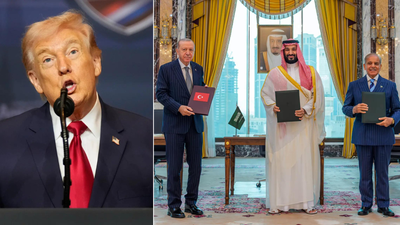
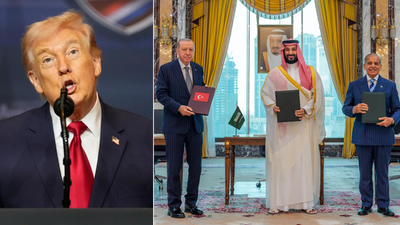
US President Donald Trump on Sunday threw his weight behind the newly signed Mecca Joint Defence Agreement between Saudi Arabia, Turkey and Pakistan, calling it a “big, bold, and important first step”.The pact, signed on August 7, has brought the three major Islamic nations closer on defence and has already drawn comparisons with Nato’s collective defence principle.Its resemblance to Nato’s core principle has also earned the grouping the moniker “Islamic Nato.”Trump praised the agreement in a post on Truth Social, saying it showed that “the Middle East is coming together” and that countries would now be able to defend themselves “in a more meaningful way”.“Very happy to see that Saudi Arabia, Turkey, and Pakistan have recently, and finally, signed the Mecca Joint Defence Agreement. It shows how the Middle East is coming together, and how countries will finally be able to defend themselves in a more meaningful way,” Trump said.“Congratulations to the Great Leadership of the three Nations mentioned. THIS IS A BIG, BOLD, AND IMPORTANT FIRST STEP — WOW,” Trump wrote.The agreement was signed in Jeddah by Saudi Crown Prince Mohammed bin Salman, Turkish President Recep Tayyip Erdogan and Pakistan Prime Minister Shehbaz Sharif. Its central message is simple but significant: “an armed attack on one of the three countries will be treated as an attack on all three.”That commitment has immediately triggered comparisons with Nato’s Article 5, under which an attack on one member is treated as an attack on the alliance.
What is the Mecca deal?
The Mecca agreement is aimed at taking defence cooperation between Saudi Arabia, Turkey and Pakistan to a new level. Beyond military exercises and arms deals, it creates a formal commitment to collective defence and deterrence.The agreement is reportedly based on Article 51 of the UN Charter, which recognises the right of countries to individual and collective self-defence.Officials have also outlined areas of cooperation including military training, personnel exchanges and joint exercises. Reports suggest the pact could also deepen intelligence-sharing among the three countries.However, there are still important details that remain unclear. The full text of the agreement has not been made public, leaving questions over the exact military obligations, the geographical limits of the defence guarantee and the circumstances that would trigger a joint response.Unlike the earlier Saudi-Pakistan Strategic Mutual Defence Agreement, the new trilateral pact does not publicly mention nuclear weapons or a nuclear-sharing arrangement.
Why it matters for India
The emergence of what is being described as an “Islamic Nato” has also caught India’s attention.New Delhi said it is examining the agreement for its possible impact on national security as well as regional peace and stability.“As far as this agreement is concerned, we are examining its implications both from the perspective of India’s national security and considerations of regional peace and stability,” external affairs ministry spokesperson Randhir Jaiswal said on August 11.“India remains fully committed to safeguarding its national interests and will take all necessary measures in this regard,” MEA said.Pakistan, a member of the grouping, has remained a persistent source of tension for India, particularly in the wake of the Pahalgam massacre. Relations between the two countries have since deteriorated sharply, with India downgrading diplomatic ties with Islamabad.

✍️ Vikrant Kharwar
Vikrant Kharwar is the Founder and Editor of News Us Media. He writes about trending news, sports, entertainment, technology, and viral stories. His goal is to make news simple, informative, and easy to understand for readers across the United States and around the world.