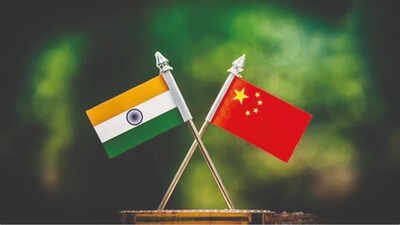








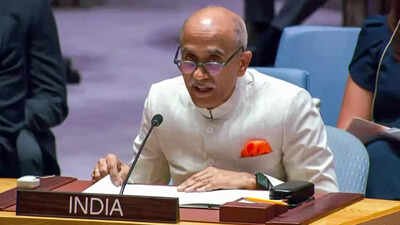
NEW DELHI: India has called for comprehensive reforms of the United Nations Security Council (UNSC), saying all permanent members of a reformed Council must have the same rights and responsibilities, including the power of veto.Delivering India’s statement at the United Nations, India’s permanent representative Parvathaneni Harish said the veto should be exercised with restraint and must not become a tool for narrow political interests, particularly on matters concerning international peace and security.India also opposed proposals to create a separate category of permanent members without the veto or with fewer powers, arguing that such an arrangement would deepen existing inequalities within the Council.“India’s position on the veto is principled and well known. It is aligned with the Common African Position. We reiterate that as long as the veto exists, it must be held by all permanent members of a reformed Council. Fairness and justice demand that all permanent members enjoy the same rights and responsibilities,” news agency ANI quoted Harish as saying.“A new category of permanent members, with or without the veto, would only further complicate a discussion that is already difficult, and would further entrench the very inequity we are seeking to correct. Periodic elections and the concept of permanency are fundamentally contradictory,” Harish added.Harish said the veto had been used 331 times on around 200 resolutions during the UN’s history. He noted that most vetoes, or threats to use them, had come from three of the five permanent members — China, France, Russia, the United Kingdom and the United States.“The record of the Veto is stark. Over the life of this Organisation, the veto has been exercised 331 times on around 200 resolutions. We also note that two out of the five permanent members have not exercised a veto for over three and a half decades, and most of the vetos or threats of vetos have emanated from only three of the P5,” he said.He also questioned the effectiveness of accountability measures introduced in 2022, under which the UN General Assembly holds a debate whenever a permanent member exercises its veto. The continued use of the veto since the mechanism was adopted showed that it had not brought the expected change, he said.
Share your thoughts in the comments
Be respectful · TOI community guidelines
He also highlighted what he described as an “effective or de facto veto” in the Council’s working methods. Under the practice of consensus, a single member can block presidential statements, press statements and decisions of sanctions committees, sometimes without providing an explanation, he said.“The veto is not only what is cast in the open. There is also the ‘effective or de facto veto’ that every Council member, elected and non-elected, holds over presidential statements, press statements and the decisions of sanctions committees, where the unwritten rule of consensus allows a single member to hold or block a proposal, most often without explanation,” Harish said.

✍️ Vikrant Kharwar
Vikrant Kharwar is the Founder and Editor of News Us Media. He writes about trending news, sports, entertainment, technology, and viral stories. His goal is to make news simple, informative, and easy to understand for readers across the United States and around the world.