







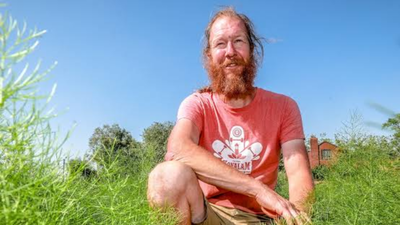
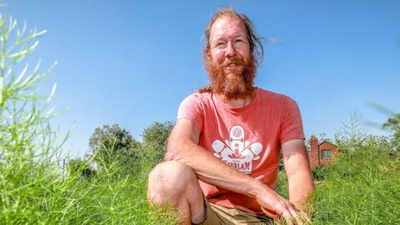
At first glance, the fields of Belgian farmer Diederik Steyaert look like they are struggling with drought. The top layer of soil appears dry, the weather is hot and there is little sign that the crops have been receiving extra water. But dig just a few centimetres beneath the surface and the picture changes. The soil is cool and moist, according to his viral Instagram video.The organic farmer from Ruddervoorde, in Belgium’s West Flanders region, says he has not given his outdoor crops an extra drop of water for 26 years, even as drought has put pressure on farmers across the region. A 2026 report on his farm says he continues to grow crops without irrigation during the current dry conditions.Steyaert runs Bioboerderij De Zaaier, an organic farm that grows vegetables and fruit on about 11 hectares. The farm began operating professionally in 2001 and has built its approach around maintaining healthy, living soil rather than depending on artificial inputs. “For 23 years, I haven’t given my outdoor crops a single drop of extra water,” said Diederik. “And yet, every year I have beautiful harvests, and my vegetables are bursting with health and flavour. My secret? Managing my soil smartly and being content with what Mother Nature provides.”
The secret is beneath the surface
Steyaert and his wife Annelies cultivate seven hectares of crops such as potatoes, fennel, red beets, lettuce, and other vegetables. They also own a one-hectare picking garden and several greenhouses. Only in the greenhouse do they give vegetables like tomatoes minimal amounts of moisture “We mainly supply our organic products to the wholesaler Biofresh or sell them in our own shop,” said Diederik. “As an organic farmer, I never use pesticides or artificial fertilisers anyway. No, I work my soil in such a way that it always remains moist.”Steyaert does not use artificial fertilisers. Instead, the farm relies on organic material such as grass, leaves, straw, hay and plant matter. Earlier reports on his farming methods described how this material is incorporated into the fields while the soil is disturbed as little as possible. He avoids ploughing and views weeds as contributors to water storage rather than problems.“Thanks to my own mixture of organic fertilisers, made from chopped straw, leaves, grasses, straw, and hay. Nothing goes to waste. We use a maximum of 125 kilos per hectare. I incorporate this into my fields and then plough as little as possible. Ploughing only causes the soil to be compacted. The result is that I have very airy soil.”Grass is piled up and left for one to two years, where rainfall is absorbed before the material breaks down into dark material that is eventually spread back onto the field. Organic matter contains fibres that can retain moisture, while the activity of bacteria, fungi and earthworms helps create a network of spaces and channels through the soil. Steyaert said this allows water to penetrate the ground while helping the soil remain porous instead of becoming compacted.In an earlier interview, he demonstrated the difference by pointing to the dry surface of one of his fields. The top layer looked parched, but only a short distance below it, the soil remained noticeably cool and damp. A 2023 report on Steyaert’s farm similarly noted that the first 10 centimetres could appear dry while the soil beneath remained moist. At that time, he said he had gone 23 years without giving his outdoor crops additional water.
Why he avoids disturbing the soil
Another part of Steyaert’s system involves reducing compaction. The farm uses GPS-guided tractors and permanent driving paths. This means machinery repeatedly travels along designated tracks rather than compressing large portions of the growing area. Less compaction allows roots to penetrate deeper into the soil and gives water more room to move through it.But Steyaert does not simply leave the surface untouched. He uses a hoeing bar with blades that cut through roughly the top two centimetres of soil. According to him, this interrupts the tiny capillary pathways through which moisture can travel towards the surface and evaporate. The result is a dry upper layer that acts almost like a protective barrier, while moisture remains below it.The method also takes time. Earlier reporting from Focus WTV said it can take around five years for a plot to build up sufficient organic matter, meaning the system cannot simply be introduced overnight.
A living soil instead of an irrigation system
Steyaert’s philosophy reflects a broader idea in soil management: healthy soil can function as a kind of natural water reservoir. Organic matter can improve a soil’s ability to retain water, while fungi, bacteria and other soil organisms contribute to its structure and nutrient cycling. Research and agricultural organisations increasingly emphasise soil health as an important tool for helping farms cope with periods of drought. MVO Vlaanderen, which has documented De Zaaier’s approach, says the farm’s soil recovered over several years after artificial fertilisers were abandoned, increasing its organic matter and water-holding capacity.At De Zaaier, the aim is therefore not to keep the entire surface permanently wet. Instead, the farm allows the upper layer to dry while protecting the moisture underneath. That distinction is important.A dry-looking field does not necessarily mean a dry root zone. For Steyaert, the real test is what is happening below the surface.
Stronger crops, according to the farmer
Steyaert also believes his approach produces more resilient plants. He has said that crops grown in his system are better able to withstand drought and other forms of stress. He also attributes fewer disease problems and good yields to the strength of the plants, while claiming that the vegetables have a fuller taste.“The advantage is that we have much stronger plants that are much more resistant. Not only to drought, but also more stress-resistant. As a result, we suffer less from diseases and have a better yield. That also results in a better taste. You get a fuller flavour from the product.”The farm grows a range of organic vegetables and fruit, and its produce is sold through its farm shop and other channels. The diversity of crops is another part of the farm’s broader approach to organic agriculture.Steyaert’s experience does not mean that every farm can simply stop irrigation. Crop type, soil composition, rainfall, climate and local water availability all determine how much water plants need. His farm’s results are also based on years of soil management rather than a single technique.But his fields offer an intriguing lesson at a time when water scarcity is becoming a growing concern for agriculture. The answer to drought may not always be found in finding more water. Sometimes, it may begin with teaching the soil to hold on to the water it already has.

✍️ Vikrant Kharwar
Vikrant Kharwar is the Founder and Editor of News Us Media. He writes about trending news, sports, entertainment, technology, and viral stories. His goal is to make news simple, informative, and easy to understand for readers across the United States and around the world.